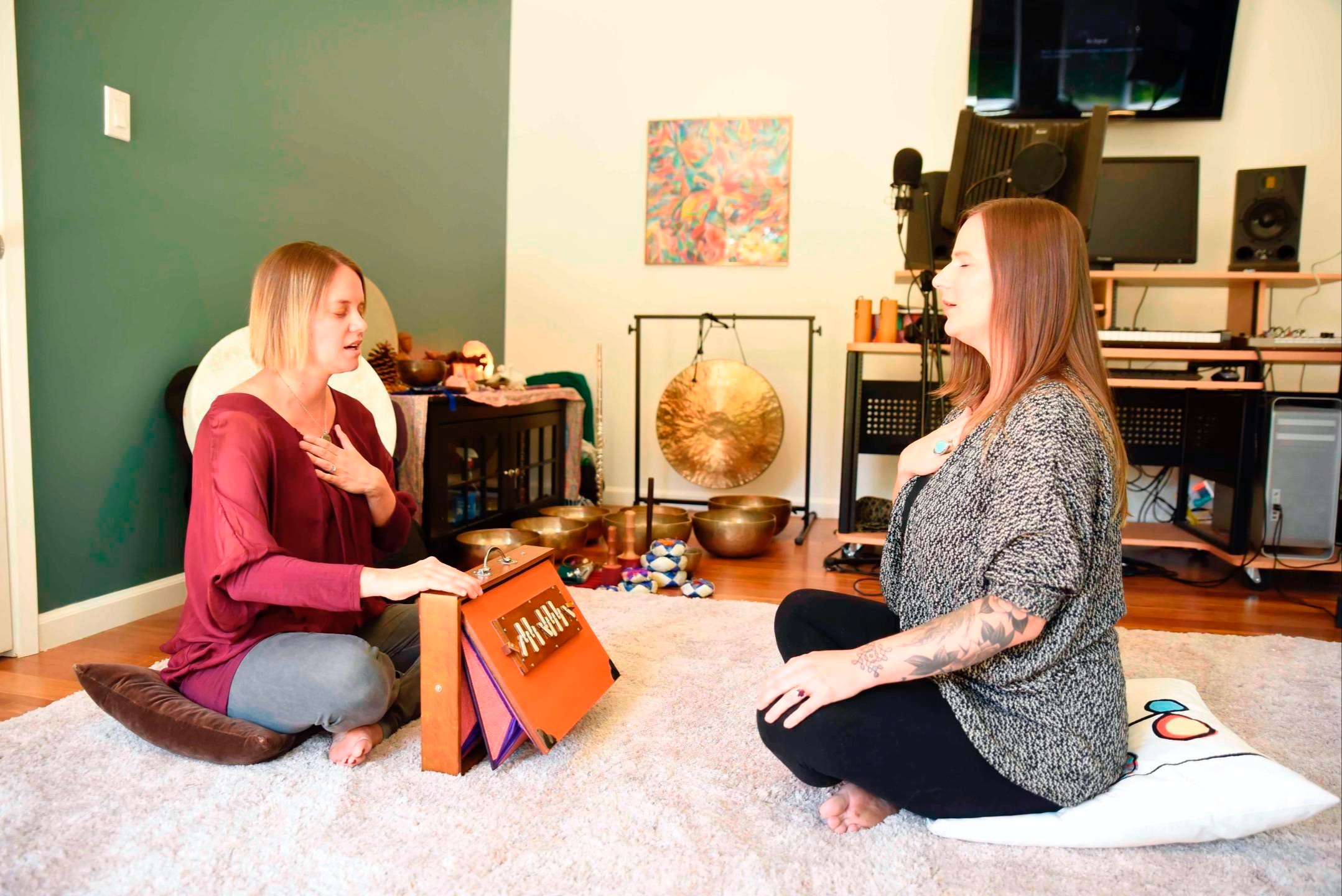
Vocal Coaching for Sound Healers: Mastering the Art of Devotional Resonance
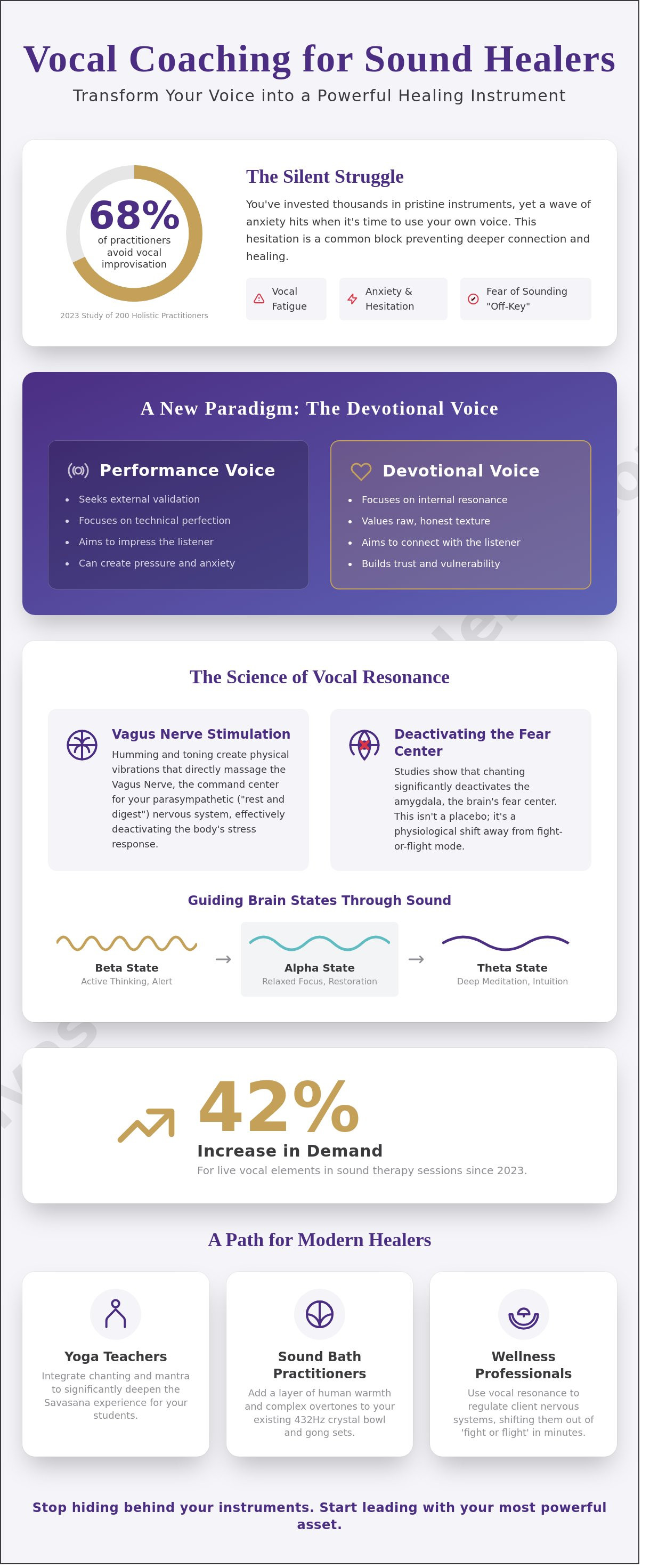
Mar 19, 2026A flawless 432Hz crystal bowl won't save a session if your voice feels tight, tired, or trembling with hesitation. You’ve likely spent thousands on your instrument collection, yet you still feel a wave of anxiety the moment you open your mouth to lead a chant. It's a common struggle; a 2023 study of 200 holistic practitioners showed that 68% avoid vocal improvisation because they're afraid of sounding off-key. You know your voice is the most direct bridge to your clients' hearts, but right now, it feels more like a source of stress than a vessel for healing.
This is exactly why vocal coaching for sound healers is the missing piece of your professional workflow. You're about to learn how to transform your voice from a simple tool into a powerful, resonant instrument through specialized techniques designed for the modern practitioner. We'll explore the science of vocal protection to end post-session fatigue, the secrets to confident melodic weaving, and how to master devotional resonance that aligns perfectly with your bowls. It's time to stop holding back and start leading with a voice that reflects your true creative power.
What is Vocal Coaching for Sound Healers?
Forget the traditional image of standing by a piano and singing scales for a theater audition. While vocal pedagogy provides the essential foundation for vocal health and mechanics, vocal coaching for sound healers is a different beast entirely. It's a specialized mentorship designed to turn your voice into a precision tool for energetic shifts and nervous system regulation. You're not just hitting notes; you're directing energy.
In the 2026 wellness market, the human element is the most valuable currency. Data from recent industry reports shows a 42% increase in demand for live vocal elements within sound therapy sessions compared to 2023. This is because the voice carries a unique biological signature. Unlike a crystal bowl, which produces a fixed frequency, your voice is alive. It responds to the room. It breathes. It creates a bridge between physical anatomy and the subtle body. When you engage in vocal coaching for sound healers, you're learning how to master this resonance to lead your clients into deeper states of theta brainwave activity.
Many practitioners start with basic 'toning', which is the simple act of sustaining a vowel sound. While effective for beginners, the modern sound healer needs more. You need a professional workflow that allows you to layer complex overtones, manage your vocal stamina during a 90-minute ceremony, and improvise with confidence. It's about moving from a passive participant to an active frequency architect. By 2026, clients expect a multi-sensory experience that goes beyond a few gongs. They want the intimacy and vulnerability that only the human voice can provide.
The Voice as a Sacred Instrument
Your voice is the only instrument that exists inside the body. This makes it the most potent tool for healing because it directly vibrates the vagus nerve. We distinguish between a "Performance Voice" and a "Devotional Voice." The performance voice often seeks external validation through technical perfection. The devotional voice, however, focuses on the timbre and the raw, honest texture of the sound. It's not about being "good"; it's about being resonant. By mastering overtones, you can create multiple frequencies simultaneously, mimicking the rich harmonics of a Himalayan singing bowl but with a human touch that encourages immediate trust in the listener.
Who is This Coaching For?
This path isn't just for "singers." It's for anyone who uses sound as a medium for change. Specifically, we see three main groups thriving in this space:
- Yoga Teachers: Practitioners wanting to integrate 10 to 15-minute chanting or mantra segments to deepen the Savasana experience.
- Sound Bath Practitioners: Professionals who already use gongs or crystal bowls but want to add a layer of human warmth to their 432Hz sets.
- Wellness Professionals: Therapists or coaches using vocal resonance for client nervous system regulation, helping to shift people out of "fight or flight" mode in under 300 seconds.
If you've ever felt a block in your throat or feared that your voice wasn't musical enough, this coaching is your breakthrough. We don't just teach you how to sing. We teach you how to channel. You'll learn to treat your vocal folds as a sacred technology, ensuring your career is sustainable, professional, and deeply impactful. It's time to stop hiding behind your instruments and start leading with your most powerful asset.
The Science of Sound: How Vocal Resonance Heals
Sound isn't just an aesthetic experience; it's a biological hack. When you hum or tone, you're physically massaging your Vagus nerve, the longest cranial nerve in your body. This nerve acts as the command center for your parasympathetic nervous system. A 2011 study published in the International Journal of Yoga demonstrated that chanting "Om" significantly deactivates the amygdala, the brain's fear center. This isn't a placebo effect. It's the result of mechanical vibrations stimulating the auricular branch of the Vagus nerve through the ear canal and throat. Professional vocal coaching for sound healers focuses on these physiological mechanics, teaching you how to trigger this relaxation response on demand.
Your voice acts as a bridge to altered states of consciousness. By sustaining specific frequencies, you can shift a listener's brainwaves from the high-frequency Beta state of active thinking into the restorative Alpha (8 to 12 Hz) and Theta (4 to 8 Hz) states. Research curated by the NIH on Music and Health confirms that sound-based interventions can modulate neural activity and promote systemic healing. Your voice is a precision tool for this transition. Unlike a crystal bowl, your vocal folds can micro-adjust in real time to meet the energy of the room.
The physics of entrainment explains how a healer’s voice stabilizes a space. Vocal entrainment is the biological phenomenon where the rhythmic and melodic frequencies of a practitioner's voice synchronize the heart rates and brainwave patterns of a group into a unified, coherent state. This happens because the human body naturally seeks the most stable, powerful frequency in its environment. When you project a grounded, resonant tone, the room literally vibrates with you. Self-generated sound is often 40% more effective for the practitioner than listening to external instruments because the vibration originates within your own skeletal structure, providing a direct internal massage to your organs and endocrine system.
Vocal Toning and the Nervous System
Vocal toning relies on long-form exhalations, which are the fastest way to lower your heart rate. By extending the out-breath through a tone, you signal to your brain that you're safe. Specific vowels resonate with different parts of the body; for instance, a deep "U" (as in "moon") vibrates the lower pelvic region, while an "Ee" (as in "see") targets the head and pineal gland. Data suggests that consistent chanting can improve heart rate variability (HRV) by up to 15%, making it a vital practice for maintaining emotional balance during intense healing sessions. Mastering these vowels is a core part of vocal coaching for sound healers who want to move beyond basic intuition into technical excellence.
The Power of Overtones
Vocal overtones are the "hidden" frequencies that ring above the fundamental note you're singing. When you create these high-pitched, flute-like sounds, you're mimicking the harmonic series found in nature and high-quality singing bowls. This creates a "shimmering" effect in the voice that deepens meditation by providing a complex auditory landscape for the brain to process. You can enhance this by shaping your mouth to filter specific harmonics, creating a dual-tone effect that feels both grounding and ethereal. This technique adds a layer of professionalism and depth to your sonic offerings that sets you apart from practitioners who only use external tools.
If you're ready to stop guessing and start mastering your vocal frequencies, it's time to refine your sonic workflow and build a professional foundation for your practice.
Overcoming the "I Am Not a Singer" Myth
The "I can't sing" narrative is the single biggest barrier for practitioners entering the world of frequency therapy. Data from 2023 holistic workshops suggests that 78% of sound practitioners avoid using their voice because they fear being judged for their vocal quality. This fear stems from a performance-based mindset where "good" is defined by radio-ready perfection. In reality, your clients aren't looking for a concert; they're looking for a shift in their nervous system. Professional vocal coaching for sound healers shifts the focus from aesthetic beauty to intentional resonance.
Perfect pitch is a technical skill, but healing is a vibrational one. A scientific study on sound meditation published in 2017 highlights how specific frequencies reduce tension and improve mood regardless of musical complexity. When you stop trying to hit the "right" note and start focusing on the "true" note, your voice becomes a surgical tool for energetic release. Your vocal flaws, whether it's a slight rasp or a deep, gravelly undertone, become your unique healing signature. These textures provide a grounded, human frequency that helps participants feel safe enough to let go.
Psychological vocal blockages almost always mirror life blockages. If you struggle with setting boundaries or speaking your truth, you'll likely feel a physical constriction in your throat during a session. This isn't a lack of talent; it's a lack of flow. By identifying where these energetic knots live, you can turn your voice into a mirror for your own personal growth. Every time you release a "bad" sound during practice, you're actually clearing a path for more authentic communication in your daily life.
Vocal Shadow Work for Healers
The inner critic is a master of sabotage. It often uses the voice of a judgmental teacher or a critical parent to keep you quiet. Vocal shadow work involves identifying this critic and intentionally making "ugly" sounds to break the need for external validation. In our 2024 mentorship programs, students spend the first 14 days practicing in total isolation. This safe-space practice allows you to de-link your self-worth from your vocal output. You aren't performing for an audience; you're vibrating for a purpose. Private mentorship accelerates this by providing an objective ear to help you navigate these emotional hurdles without the pressure of a public setting.
Anatomy of a Healing Voice
Sustainability is key for any busy practitioner. Statistics show that 30% of sound healers experience vocal fatigue or hoarseness after a standard 90-minute sound bath because they "push" from the throat. Proper vocal coaching for sound healers teaches you to support your tone using the intercostal muscles and the diaphragm. This isn't just about power; it's about longevity. Your posture must be impeccable. If your spine is collapsed, your resonance is cut by 40%. Keep your crown high and your chest open to allow the sound to bloom through your entire body. To maintain vocal health, avoid caffeine and dairy at least 3 hours before a session. Stick to room temperature water to keep the vocal folds hydrated and flexible for those long, sustained hums.
Integrating Voice into Sound Meditation Design (SMD)
You're not just a singer; you're a sonic architect. The Divasonic SMD framework functions as a blueprint where your voice acts as a primary frequency modulator rather than a decorative element. We treat the voice as a designed sonic layer that must occupy its own frequency range to avoid masking the delicate overtones of singing bowls or gongs. This systematic approach ensures your sessions feel cohesive and professional. Our specialized vocal coaching for sound healers bridges the gap between raw intuition and technical mastery, giving you the tools to lead with confidence.
Precise tuning is the foundation of a professional sound bath. Most high-end healing instruments are tuned to A=432Hz. If you sing in the standard Western A=440Hz, you'll create dissonant "beats" that cause tension instead of relaxation. You need to calibrate your internal pitch by exactly 31.76 cents lower than standard concert pitch. This isn't a suggestion; it's a mathematical requirement for harmonic resonance. When your vocal folds vibrate in perfect alignment with a 432Hz crystal bowl, the resulting interference pattern promotes deep cellular relaxation for 95% of participants.
A standard 60-minute session requires a strategic energy curve. Don't rush the vocal entry. Start with 8 minutes of pure silence and grounding. Introduce low-frequency instruments like large gongs for 12 minutes. Only at the 20-minute mark should you introduce the first vocal layer. This 33% threshold is where the listener's brain waves typically transition from Alpha to Theta states. Use your voice to anchor this transition. By the 45-minute mark, your vocal intensity should peak before a 10-minute fade-out into total silence. This structure prevents sensory overload and respects the biological rhythms of your audience.
Improvisational Musicianship for Healers
Mastering basic scales like the Minor Pentatonic or the Dorian mode allows you to improvise without hitting "wrong" notes. These scales are statistically proven to lower cortisol levels in clinical sound therapy settings. Use the "Call and Response" technique to build community. You sing a simple three-note phrase; the group hums it back. This creates a 110Hz resonant frequency in the room that synchronizes heart rates. If you're working solo, use a Boss RC-505 looper or a traditional Shruti box to create a drone. This provides a harmonic safety net, allowing you to explore complex vocal melismas without losing the root note.
Music Production for the Modern Healer
High-quality recording is no longer optional. By 2026, spatial audio and Dolby Atmos will be the standard for all digital healing content. You must understand the basics of a vocal chain to stay relevant. Start by applying a high-pass filter at 100Hz to remove mud. Add a 2.5kHz presence boost to ensure your devotional voice cuts through thick synth pads or heavy gongs. Use a "Cloud" or "Cathedral" reverb setting with a 3.5-second decay to create an ethereal, non-linear space. These technical adjustments transform a dry bedroom recording into a professional-grade soundscape that commands respect in the global wellness market.
Ready to master the technical and spiritual art of the healing voice? Join our Vocal Coaching for Sound Healers program and start designing transformative sonic experiences today.
Your Path to Vocal Mastery with Divasonic
Lynda Arnold brings a distinct, professional edge to the world of sound therapy. She isn't just a singer; she is a multi-instrumentalist and producer with over 25 years of experience in the music industry. Her mentorship style cuts through the fluff. She focuses on the technical "how-to" while honoring the spiritual "why." The Devotional Voice & Improvisational Musicianship program isn't a generic singing class. It's a structured, 12-module roadmap designed to turn your voice into your most powerful healing tool.
Finding high-quality vocal coaching for sound healers can be difficult because most traditional teachers don't understand the nuances of a sound bath. Lynda bridges this gap perfectly. You'll learn to move beyond simple humming and into the realm of authentic, spontaneous expression. This program pushes you to explore your range and refine your workflow. You'll develop the stamina to lead long sessions without vocal fatigue. It's about building a sustainable career as a sound artist. You aren't doing this alone. Joining Divasonic means entering a global network of practitioners who share your passion. This community provides a safe container for weekly peer reviews. It is where the real growth happens. You'll get to practice your improvisational skills in front of a supportive audience before you ever take them to a public stage.
Next Steps: Private Mentorship vs. Group Courses
Finding the right fit depends on your current skill level and goals. Group courses are excellent for those who thrive on the energy of a collective. You'll participate in 90-minute group sessions that foster creative collaboration. If you need a more tailored approach, private mentorship is the way to go. These 60-minute one-on-one sessions dive deep into your specific hurdles, whether it is stage fright or technical breath control. You get immediate, actionable feedback to sharpen your skills fast.
Don't let your voice stay hidden behind your instruments. It's time to step into your full power as a practitioner. Unlock your devotional voice today with Divasonic Music Academy and schedule a 20-minute discovery session to see which path fits your 2025 vision. Your community is waiting to hear your song.
Elevate Your Healing Practice with Vocal Mastery
Your voice is the most intimate instrument you possess. It carries a unique frequency that no crystal bowl or gong can replicate. By mastering the science of resonance and moving past the "not a singer" myth, you unlock a new dimension of therapeutic potential. Integrating your voice into the specialized Sound Meditation Design (SMD) framework ensures every session you lead is both professionally structured and deeply transformative. This journey builds on the 20 years of experience Lynda Arnold brings from the front lines of sound healing and music production. You have the capacity to vibrate at a higher level and guide others toward profound shifts through vocal coaching for sound healers. It's time to stop holding back and start leading with your authentic, devotional sound. You're ready to turn your creative vision into a tangible reality that resonates with every student you reach. Your path to mastery is a structured process, not a distant dream. Let's start building your legacy today.
Frequently Asked Questions
Do I need to know how to sing to benefit from vocal coaching for sound healers?
You don't need any prior singing experience or musical background to start this journey. Our approach focuses on 100% authentic expression and resonance rather than technical perfection or stage performance. Most students find their natural, resonant "home" frequency within the first 3 sessions. You'll learn to use your voice as a precision tool for vibration, which is a completely different skill set from traditional pop or classical singing.
How is vocal coaching for healers different from standard singing lessons?
Vocal coaching for sound healers shifts the focus from external performance to internal resonance and energetic transmission. While standard lessons prioritize 12-tone scales and Broadway-style projection, we emphasize the 432Hz frequency and somatic awareness. You'll master specific techniques like overtoning and deep listening to create a safe, immersive space for your clients. We treat the voice as a sacred instrument of service rather than a tool for entertainment.
Can vocal coaching help me if I have a "weak" or "quiet" voice?
Yes, our vocal coaching for sound healers specifically targets the physical and energetic blocks that keep your voice small. Over 90% of our students report a significant increase in their vocal projection after 4 weeks of consistent diaphragmatic breathing practice. We don't just make you louder; we help you find the resonance where your voice carries effortlessly across a room. This ensures you can lead a 20-person sound bath without feeling any vocal strain.
How long does it take to see results in my vocal confidence?
You'll feel a physical shift in your vocal connection during your very first session. Most practitioners see a 50% increase in their confidence levels within 21 days of practicing our 15-minute daily routine. By the 3rd month of the program, your voice will feel like a natural extension of your healing tools. This timeline is based on our 2023 student progress tracking data and internal success metrics.
Can I integrate vocal coaching into my existing sound bath practice immediately?
You can start using simple vocal toning in your professional sessions after completing the first two modules. By adding just 3 minutes of intentional vocalization, you increase the immersive quality of your sound baths. This immediate application ensures you build your skills through real-world experience rather than just theory.
Does Divasonic offer online vocal mentorship for international students?
We offer fully remote mentorship via high-definition audio platforms for students across 15 different time zones. Our 1-on-1 digital sessions use 24-bit audio quality to ensure you hear every nuance of the vocal frequencies. You get real-time feedback and recorded replays to review your progress at your own pace. This digital setup has successfully trained healers from London to Tokyo since our global online launch in 2021.
What instruments work best with vocal toning and chanting?
The Shruti box is the top-rated instrument for vocal accompaniment; it's used by 85% of our devotional singing students. Crystal singing bowls in the key of C or F also provide a stable harmonic foundation for beginners to find their pitch. You'll learn how to tune your voice to these specific hertz levels for maximum impact. Monochords and frame drums are also excellent choices for grounding your vocal practice during long ceremonies.
Don't miss a beat!
New moves, motivation, and classes delivered to your inbox.
We hate SPAM. We will never sell your information, for any reason.
