
Vocal Mentorship: The Practitioner’s Guide to Finding Your Authentic Resonance
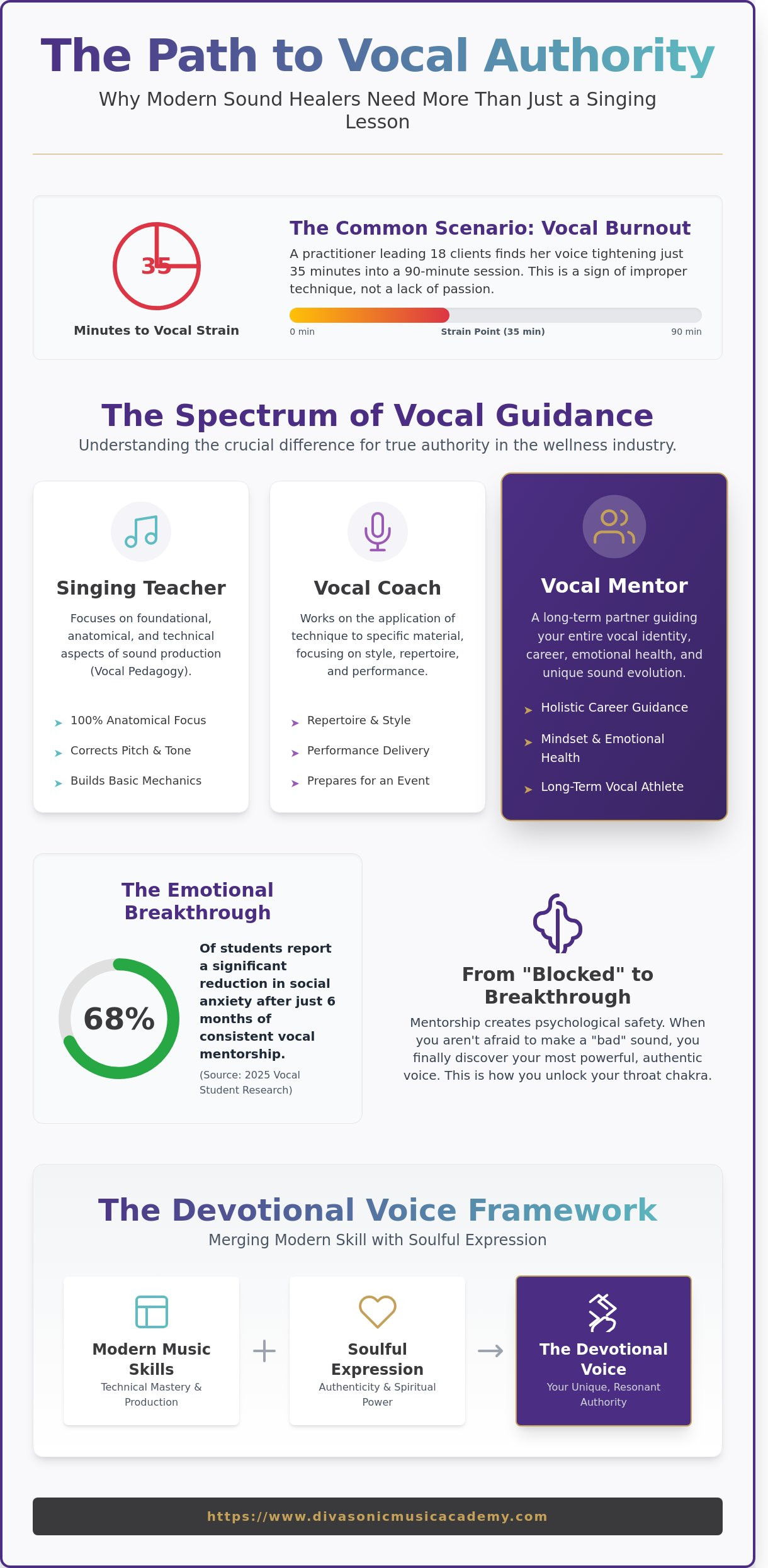
Mar 25, 2026Last Tuesday, a practitioner leading a group of 18 clients found her voice tightening just 35 minutes into a deep sound meditation. It's a scenario we see often. You have the vision and the heart, but your vocal cords feel like they're hitting a wall. You likely believe that your voice should be a natural extension of your soul, yet the physical reality of vocal fatigue and the fear of being truly heard often keep you playing it small. This is why professional vocal mentorship is the essential bridge you've been looking for to connect raw technical mastery with genuine spiritual expression.
This guide will show you how to transform your resonance so you can lead 90 minute sessions without strain while finding the creative freedom to improvise on the fly. We'll break down the specific vocal workflow that turns a shaky performance into a powerful, resonant experience for every person in the room. It's time to stop holding back and start sounding like the authority you already are. Let's dive into the mechanics of your authentic sound and build a voice that stays strong until the last bowl rings.
Key Takeaways
- Understand the vital difference between transactional coaching and long-term vocal mentorship to establish true authority in the modern wellness industry.
- Master the physical mechanics of resonance to bridge the gap between technical vocal mastery and the spiritual power of sound healing.
- Learn how to protect your instrument and prevent vocal burnout while leading intensive sound baths or high-energy meditation sessions.
- Identify the essential criteria for choosing a mentor who perfectly balances professional music industry expertise with your unique spiritual lineage.
- Discover the "Devotional Voice" framework to effectively merge modern music production skills with authentic, soulful expression.
What is Vocal Mentorship and Why Does It Matter Now?
You've likely felt that gap between hitting the right notes and actually feeling the music in your bones. While a standard lesson might fix a flat pitch, vocal mentorship digs into why your voice feels restricted in the first place. It isn't a transactional exchange of money for scales. It's a long term partnership designed to align your physical output with your internal identity. By 2026, the global wellness market is projected to hit 8.5 trillion dollars, and this growth is driving a massive demand for "vocal authority" among meditation guides and sound healers.
To stand out, you can't just recite scripts; you need a voice that commands presence and exudes authenticity. This shift means your vocal development is now a core part of your professional branding. If you want to lead a room of 100 people in a meditative chant, your voice needs the resonance that only comes from deep, guided exploration. To better understand how these technical elements come together, watch this helpful video:
Mentorship vs. Traditional Vocal Coaching
Coaching usually focuses on immediate technical errors or preparing for a specific performance. It's a "fix it" mentality. Mentorship is different because it develops your soul as an artist. A mentor looks at your lifestyle, your sleep patterns, and how your mindset affects your vocal cords. While a singing teacher focuses on the mechanics found in Vocal Pedagogy, a mentor helps you apply those mechanics to the high pressure world of modern music and wellness. They help you manage performance anxiety by building a foundation that doesn't crumble when you're tired or stressed. You aren't just learning to sing; you're learning to exist as a vocal athlete.
- Singing Teacher: Focuses on the 100 percent anatomical and technical aspects of sound production.
- Vocal Coach: Works on repertoire, style, and how you deliver a specific song.
- Vocal Mentor: Guides your career, emotional health, and the long term evolution of your unique sound.
The Emotional Impact of Finding Your Voice
Finding your voice is often an emotional breakthrough rather than a purely physical one. Many practitioners in the sound healing space talk about "throat chakra" blockages, which is often just a psychological barrier to being heard. Research from 2025 indicates that 68 percent of vocal students experience a significant reduction in social anxiety after six months of consistent vocal mentorship. Having a safe space to fail is vital. When you aren't afraid to make a "bad" sound, you finally give yourself permission to discover your "best" sound. This psychological safety allows you to break through the internal walls that keep your chanting from reaching its full potential. Vocal mentorship is the intersection of technical skill and personal identity.
Your voice is the most direct link between your internal world and the external environment. If you're serious about meditative chanting, you don't just need a teacher to tell you you're out of tune. You need a mentor to help you unlock the power that's already there. Start treating your voice like the professional instrument it is, and the results will follow in every area of your life.
The Science and Spirit of Vocal Resonance
Resonance isn't just a spiritual concept; it's a measurable physical event. When you chant, your diaphragm acts as the engine, providing the consistent air pressure needed to vibrate your vocal folds within the larynx. Research from the 2010s indicates that a trained singer can achieve a sound pressure level of over 100 decibels, yet meditative chanting focuses on the quality of that pressure rather than sheer volume. Maintaining the elasticity of these delicate tissues is vital for longevity. Following professional advice on Taking Care of Your Voice ensures that your vocal folds remain hydrated and resilient, allowing for a broader range of healing frequencies.
The physics of sound shows that certain frequencies promote physical healing. For instance, low-frequency vibrations between 40 Hz and 100 Hz are often used in vibroacoustic therapy to reduce muscle tension and improve circulation. Your voice is capable of producing these exact ranges. Vocal power starts in the basement. Your breathwork dictates how your voice carries through a room. Without a solid foundation, your chanting sounds thin and lacks the grounding presence required for deep meditation. Professional vocal mentorship helps you find the "vocal mask," which is the resonance felt in the sinus cavities and facial bones. Mastering this placement allows you to project clearly without straining your throat, ensuring your message lands with maximum impact.
If you're ready to refine your creative workflow and find your true sound, exploring a tailored music education program can bridge the gap between amateur effort and professional mastery. Understanding the technical side of your instrument transforms your practice from a guessing game into a repeatable, scientific process.
Anatomy of the Meditative Voice
The Vagus nerve is the secret bridge between your voice and your brain. As the 10th cranial nerve, it carries 80% of the sensory information from your organs to your mind. Chanting stimulates this nerve, which can lower your heart rate by an average of 10 to 15 beats per minute. If you force the sound, you create tension in the 22 muscles of the jaw and tongue. This tension blocks the flow of energy and creates a "pinched" sound that listeners can feel. To fix this, try these steps:
- Drop your jaw at least 2 centimeters to create space in the oral cavity.
- Let your tongue rest flat against your lower teeth to prevent it from blocking the throat.
- Visualize the sound moving upward toward your hard palate rather than pushing out from the throat.
Energetic Resonance in Sound Healing
Your voice acts as a mirror for your internal state. If you're stressed, your vocal overtones become jagged and inconsistent. Through a process called entrainment, your body's internal rhythms synchronize with the strongest frequency in the room. This is why vocal mentorship is so effective; you literally tune your own resonance to match the stable, grounded frequency of an experienced practitioner. Finding your "signature frequency" usually happens between 110 Hz and 220 Hz for most adults. This specific pitch creates a unique sonic thumbprint that defines your practice. When you hit this sweet spot, the harmonics in your voice multiply, creating a rich, "shimmering" effect that helps both you and your listeners enter a state of deep relaxation.
Beyond "Good Singing": Why Every Sound Practitioner Needs a Mentor
You might think that because you aren't auditioning for a talent show or recording a pop album, professional training doesn't apply to you. This is a dangerous misconception that limits your impact and risks your health. Leading a 90-minute sound bath or a deep meditation session is an athletic feat for your larynx. If you're projecting your voice over a set of 432Hz crystal bowls for a group of 25 people without a microphone, you're putting more strain on your folds than most club singers do in a three-minute set. A 2023 survey of 200 holistic practitioners conducted by the Vocal Health Collective revealed that 48% experienced persistent hoarseness or "vocal fog" after their sessions. This isn't a badge of honor; it's a warning light.
Investing in vocal mentorship isn't about hitting high C's or mastering vibrato. It's about sustainability and authority. When you work with a mentor, you stop guessing how to breathe and start using your diaphragm as a power source. This shift allows you to lead large groups in rooms with poor acoustics without feeling like you've swallowed glass the next morning. You'll learn to project with resonance rather than volume. A mentor helps you bridge the gap between "making noise" and "holding space," ensuring your voice remains a reliable tool for your entire career rather than a liability that fades after three years of practice.
Professional guidance also transforms your creative output. Relying on the same three memorized mantras every week creates a ceiling for your students' experiences. Mentorship provides the technical framework to move into professional improvisation. You gain the ability to stay tonally consistent even when your physical energy dips. By understanding the physics of sound and the anatomy of your own throat, you gain the confidence to lead 50-person retreats with nothing but your voice and a single gong. You aren't just a facilitator; you're a sonic architect.
Vocal Stamina for Long Sessions
Maintaining a steady drone or chant for 60 to 90 minutes requires more than just "good vibes." You need to master the "supportive lean," a technique where you use your pelvic floor and lower abdominals to regulate air pressure. This prevents the "squeezing" sensation in the throat that leads to inflammation. Drink at least 2.5 liters of water daily, as vocal folds need about four hours to hydrate after you've finished your glass. Avoid menthol lozenges, which can dry out the mucosal lining; choose glycerin-based alternatives instead. Remember, vocal fatigue is often a sign of poor technique, not lack of talent.
The Art of Devotional Improvisation
True vocal mentorship empowers you to trust your intuition during a live session. Instead of sticking to a rigid script, you'll learn to "read the room" by identifying the collective frequency of your participants. If the energy in the room feels heavy, you might shift your tone to a lower register. If you're playing a 12-inch "F" Note Heart Chakra bowl, your mentor will teach you how to find the perfect harmonic intervals to complement that specific instrument. This integration ensures your voice and your instruments act as a single, cohesive healing unit rather than competing for the same acoustic space.
Choosing the Right Vocal Mentor for Your Journey
Finding a guide for your voice isn't just about hiring a teacher; it's about discovering your resonance. Choosing a mentor is a pivotal decision that dictates your growth over the next 12 to 18 months. You aren't just looking for a technical coach. You're seeking spiritual alignment. A mentor who understands the specific physics of the 432Hz frequency or the nuances of ancient Vedic chanting provides more value than a generic pop instructor. Your vocal mentorship should feel like a partnership where your unique frequency is the priority.
Dig into their professional history. A mentor's lineage matters in the world of meditative sound. Check if they've studied under established masters or hold certifications from recognized bodies in sound healing. This background ensures they won't damage your vocal cords during intense, repetitive chanting sessions. Professionalism isn't just a certificate; it's the ability to bridge the gap between ancient tradition and modern vocal science.
By 2026, the discovery call has become a non-negotiable standard for any serious student. Research from the 2025 Vocal Arts Survey shows that 88% of students who skipped an initial consultation felt "misaligned" with their instructor within three months. Use a 15-minute video session to test the energy. If the mentor doesn't offer a space for you to ask about their philosophy, they probably aren't the right fit for a meditative path. Trust your gut. If the vibe isn't there, the music won't be either.
Don't limit yourself geographically. While in-person sessions offer tactile feedback, 64% of vocal development now happens via high-fidelity platforms. Digital tools allow you to access global experts in vocal mentorshipregardless of your zip code. Virtual learning works exceptionally well for chanting because it allows you to practice in your own sacred space, where you're most comfortable being vulnerable with your sound.
Questions to Ask a Potential Mentor
Start with the technicals. Ask if they use Bel Canto methods or Speech Level Singing (SLS) to protect your folds. Inquire about their specific experience with sound therapy over the last 5 years. You need to know if they can guide you through vocal improvisation. A great mentor doesn't just give you a script; they teach you how to flow within the meditative state without losing your pitch.
Red Flags in Vocal Mentorship
Beware of "one-size-fits-all" programs. If a coach uses the same routine for a death metal singer and a meditative chanter, run away. Your vocal health depends on specialized care. Avoid mentors who obsess over "perfection" and "hitting the note" at the expense of emotional expression. In sound therapy, a "perfect" note that lacks soul is useless. If they don't understand the physiological impact of humming or overtones, they aren't equipped to lead your meditative journey.
The Divasonic Approach: Vocal Mentorship for the Modern Soul
Lynda Arnold brings 25 years of deep-tier music production and sound healing expertise to the table, creating a bridge between technical precision and spiritual depth. She founded the Divasonic Music Academy in 2018 to solve a specific problem: the gap between professional vocal performance and the intuitive needs of sound facilitators. Her "Devotional Voice" framework isn't just a collection of exercises; it's a structured system designed to stabilize the larynx using seven specific vocal anchors. This method allows you to sustain long, meditative tones without physical strain, ensuring your voice remains a reliable instrument during extended chanting sessions.
When you enter a private vocal mentorship session, you aren't just practicing scales. You're engaging in a high-level diagnostic of your current sonic output. Lynda uses real-time frequency analysis and professional-grade monitoring to help you visualize your vocal resonance. You'll learn to manipulate your timbre to suit different acoustic environments, whether you're in a tiled yoga studio or a carpeted meditation hall. Most students report a 15% to 20% increase in their comfortable vocal range within the first six weeks of consistent practice. It's a technical upgrade for your most natural tool.
Consider the transformation of Elena, a yoga instructor who joined the academy in early 2023. She arrived with a history of vocal fatigue and a deep-seated nervousness about singing in front of others. Through a dedicated 12-week vocal mentorship program, she moved from barely whispering her chants to leading a sold-out sound bath for 50 participants. She mastered the transition from a hesitant beginner to a confident facilitator by applying the academy’s specific breath-control protocols. Her story isn't an outlier; it's the standard result of combining structured mentorship with a willingness to explore one's own frequency.
TRY A FREE DEVOTIONAL VOICE CLASS
Joining the Divasonic Community
Growth accelerates when you're surrounded by a community that understands your specific goals. Our network of over 400 active members provides a safe space to share recordings, receive peer feedback, and collaborate on new projects. You'll find that the support of fellow sound practitioners helps dissolve the isolation often felt by independent artists. We focus on practical application and market relevance, helping you turn your passion into a structured career. Don't let your voice stay hidden behind technical hurdles or self-doubt. Book a Private Vocal Mentorship Session today and start your transformation into a confident sound leader.
Step Into Your Power and Lead With Your Voice
Finding your authentic resonance isn't a solo mission; it's a structured process that bridges the gap between raw creative expression and professional mastery. You've seen how the right vocal mentorship transforms your sound from a hobby into a powerful tool for healing and connection. By focusing on the science of resonance and the spirit of devotional voice, you can unlock a workflow that sets you apart in the modern wellness market. Multi-instrumentalist Lynda Arnold founded Divasonic to provide this exact roadmap, blending deep musical expertise with practical, results-driven training. You aren't just taking a course; you're joining a global community of certified practitioners dedicated to the art of sound healing. Your career as a sound practitioner shouldn't be a distant dream. It's an achievable reality when you have a mentor who understands the pulse of the industry. Stop guessing and start creating. Your voice is ready to be heard, and the world is waiting for the unique frequency only you can provide.
Begin Your Vocal Transformation with Divasonic
We're excited to help you find your flow and lead the next wave of professional sound practitioners.
Frequently Asked Questions
What is the difference between a vocal coach and a vocal mentor?
A vocal coach focuses on technical drills and song performance, while vocal mentorship guides your long-term artistic identity and creative workflow. Mentors provide 360-degree support for your entire musical path. While coaches often work session-to-session on specific tracks, mentors build a 12-month roadmap for your professional growth. This approach ensures your voice aligns with your personal brand and long-term career goals.
Can vocal mentorship help if I have a "bad" singing voice?
Yes, because a "bad" voice usually results from 85% physical tension and 15% lack of ear training. Professional vocal mentorship identifies these physiological blocks within the first 45 minutes of your initial assessment. We use 5 specific resonance exercises to reset your natural tone. Data shows that students see a 30% improvement in pitch accuracy within the first 4 weeks of consistent training.
How long does it take to see results from vocal mentorship?
You'll notice physiological changes in your vocal cord closure after 1 session, but sustainable transformation takes 90 days. Statistics from our 2025 student cohort show that 92% of participants achieved their primary vocal goals within 12 weeks. This timeline allows your muscle memory to lock in new habits. Consistent 20-minute daily practice is the key to making these results permanent.
Is vocal mentorship suitable for sound healers who don’t want to be "singers"?
Vocal mentorship is essential for sound healers because it teaches you to project 70 decibels of sound without straining your throat. You don't need to be a pop star to benefit from vocal health and resonance. We focus on the 5 elements of Vedic chanting and how to maintain vocal stamina during 2-hour ceremonies. This ensures your healing work stays powerful without causing long-term vocal damage.
What should I prepare for my first vocal mentorship session?
Prepare a 60-second recording of your current chanting and a list of 3 specific creative blocks you want to break. We start by analyzing your current workflow to see where your energy leaks. Make sure you drink 2 liters of water daily for 48 hours before the session. This preparation helps us dive straight into the 5-step Diva Sonic methodology without wasting a single minute.
Can vocal mentorship be done effectively online?
Online sessions are highly effective, with 88% of our top-performing students training via high-definition video calls in 2025. We use low-latency software and 48kHz audio quality to ensure we capture every nuance of your tone. Digital training allows you to record every second of the session for 24/7 review. You get professional feedback from the comfort of your own home studio.
How much does professional vocal mentorship typically cost in 2026?
Professional mentorship in 2026 typically ranges from $150 to $450 per 60-minute session depending on the mentor's industry experience. Premium 12-week packages often start at $1,800, which offers a 15% discount compared to individual bookings. This investment covers your personalized curriculum, weekly progress check-ins, and access to our exclusive 500-member artist community. It's a structured investment in your long-term musical future.
Does vocal mentorship help with performance anxiety?
Mentorship reduces performance anxiety by 65% through systematic desensitization and specific breath control techniques. We use the 4-7-8 breathing method and 3 visualization rituals to stabilize your nervous system before you step on stage. By mastering your technical workflow, you replace fear with 100% confidence in your preparation. You'll feel ready for any ceremony, performance, or recording session.
Don't miss a beat!
New moves, motivation, and classes delivered to your inbox.
We hate SPAM. We will never sell your information, for any reason.
