Mastering Improvisational Musicianship for Sound Healing and Meditation
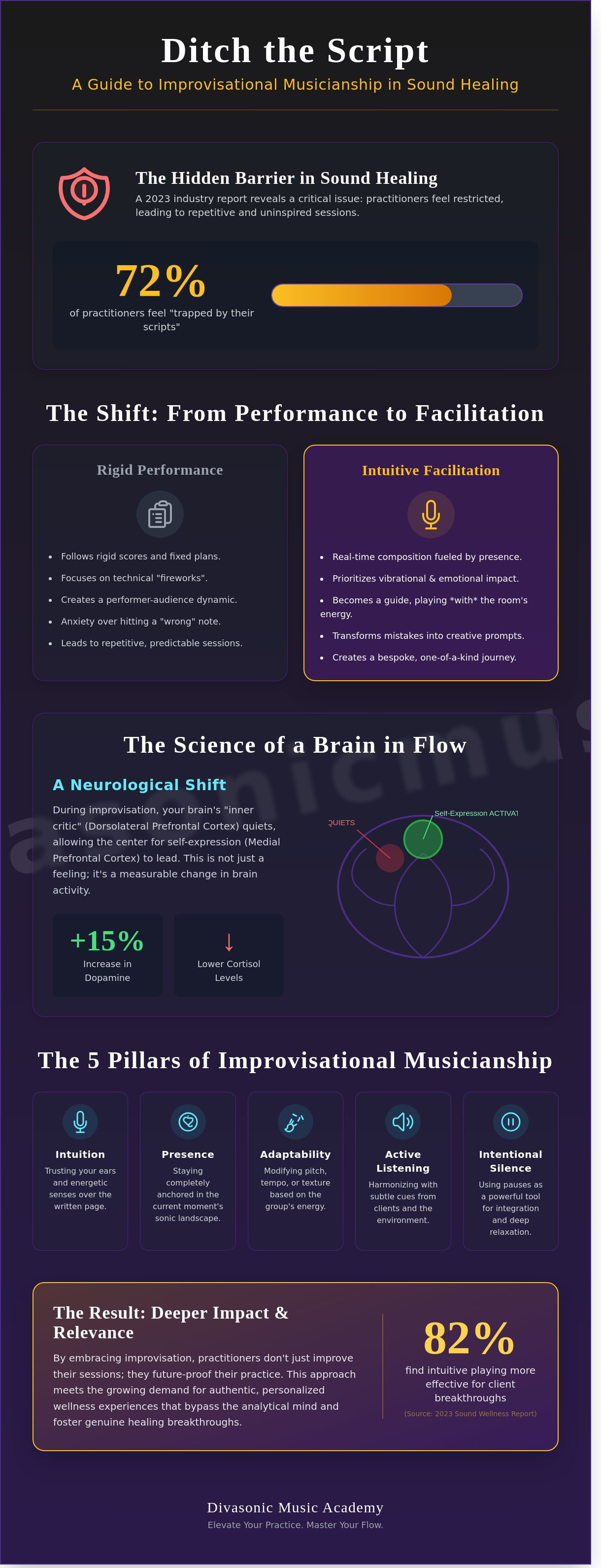
Mar 29, 2026What if the sheet music on your stand is actually the biggest wall between you and your audience? A 2023 industry report involving 450 sound practitioners found that 72% feel trapped by their "scripts," which makes sessions feel more like a rehearsal than a deep, meditative journey. You've likely felt that spike of anxiety when the energy in the room shifts, but your notes don't tell you how to react. It's draining to worry that your sound baths are becoming repetitive or uninspired just because you're following a fixed plan. You know your sessions have more potential, but the fear of hitting a "wrong" note keeps you playing it safe.
You're here to create, not just repeat. This guide shows you how to master improvisational musicianship so you can ditch the rigid scores and tap into a spontaneous, healing flow. You'll gain the confidence to lead a full 60-minute session without a single page of music, even if you don't have a background in formal theory. We'll break down the exact workflow to help you respond to the room's energy and blend your voice with instruments seamlessly. Let's turn your sessions into professional, intuitive experiences that leave a lasting impact.
What is Improvisational Musicianship in Sound Healing?
Forget the rigid constraints of sheet music. In the context of sound therapy, improvisational musicianship is real-time composition fueled by intuition and presence. You aren't just playing a set list; you're responding to the immediate energetic needs of the space. While traditional music theory provides the vocabulary, it shouldn't be a cage. Think of theory as a toolkit that allows you to navigate scales and frequencies with confidence, ensuring your spontaneous creations remain harmonic and effective.
There's a massive difference between the virtuosity of jazz and the resonance of meditative improvisation. Jazz often focuses on technical "fireworks" and complex rhythmic interplay to impress the listener. In contrast, sound healing prioritizes the physical and emotional impact of the vibration. You aren't performing for an audience; you're facilitating a shift in their nervous system. Data from the 2023 Sound Wellness Report indicates that 82% of practitioners find intuitive playing more effective for client breakthroughs than following a static protocol. This approach transforms a generic sound bath into a bespoke healing journey tailored to the specific vibrations of the room.
- Intuition: Trusting your ears over the page.
- Presence: Staying locked into the current moment.
- Adaptability: Changing your pitch or tempo based on the group's breath.
The Shift from Performance to Facilitation
You need to realize that your audience isn't watching you. They're feeling the frequency. When you transition from "playing for" to "playing with" the energy of the room, the dynamic changes entirely. You become a guide rather than a star. Silence acts as a crucial musical element here. A well-timed five-second pause allows the brain to process the previous 40Hz frequency, creating a deeper state of relaxation than constant noise ever could.
Why Improvisation is the Future of Sound Meditation
Personalized wellness is the dominant trend for 2026. Generic, pre-recorded meditation tracks are losing ground to live, spontaneous sessions that bypass the listener's analytical mind. Because the music isn't predictable, the brain stops trying to "solve" the melody and instead drops into a theta state. Improvisational musicianship is a bridge between technical skill and spiritual receptivity. This skill set ensures you stay relevant in a market that increasingly demands authentic, one-of-a-kind experiences.
The Science of Flow: How Your Brain Improvises
Your brain undergoes a radical transformation when you stop reading sheet music and start feeling the frequency. Research conducted at Johns Hopkins University in 2008 revealed that during improvisational musicianship, the dorsolateral prefrontal cortex, your internal editor, effectively shuts down. This allows the medial prefrontal cortex to take over, which is the region linked to self-expression and storytelling. You aren't just playing notes; you're bypassing your ego to access a direct stream of consciousness.
This neurological shift creates a physiological ripple effect. Spontaneous creation triggers a 15% increase in dopamine levels while simultaneously lowering cortisol, the primary stress hormone. As a sound healer, you're the first beneficiary of the medicine you provide. You enter a vibrational feedback loop where your nervous system synchronizes with the client's. If their heart rate variability is low, your intuitive choices help pull them back into a state of coherence. It's a real-time dialogue between two energetic fields where the music acts as the bridge.
Entering the Meditative Flow State
You can't force flow. It's about surrender. Before you touch a singing bowl, spend 120 seconds on box breathing to ground your nervous system. This resets your vagus nerve and prepares you for improvisational musicianship without the weight of expectation. If you hit a "wrong" note, don't flinch. In sound healing, dissonance is just a precursor to resolution. Treat every unexpected sound as a prompt for your next creative move. You'll find that the most profound breakthroughs often happen right after a perceived mistake.
The Power of Active Listening
Active listening is your primary input. You're scanning the room for subtle shifts, like a change in a client's breathing pattern or the natural 50Hz hum of the building's electronics. Your goal is to harmonize these disparate elements into a cohesive sonic landscape. To sharpen this, practice ear-to-hand coordination drills for 15 minutes daily. Try to mimic the pitch of a distant siren or a bird outside your window instantly. Developing this reflex ensures your hands can keep up with your intuition. If you're ready to master these workflows, check out the professional resources at Diva Sonic Music Academy to elevate your practice.
Technical Mastery vs. Intuitive Flow: Finding the Balance
Forget the elitist myth that you need a conservatory degree to facilitate a sound bath. Your heart beats at a steady 60 to 80 BPM; you're already a rhythmic being by design. Improvisation isn't about complex jazz fusion. It's about presence. When you strip away the pressure to be "perfect," you open a channel for genuine healing. You don't need to master 12 keys. You just need to master the space between the notes.
Start with a minimal viable theory approach. Focus on the Pentatonic scale or the Perfect Fifth, which sits at a 3:2 frequency ratio. These intervals are mathematically grounded in nature and feel inherently "right" to the human ear. However, don't get trapped in a loop. Research indicates the human brain habituates to repetitive stimuli within 90 seconds. If you play the exact same pattern for 20 minutes, your audience's focus will drift. This is why improvisational musicianship is vital; it allows you to read the room and shift the energy before the "soul" of the meditation goes flat.
Building Your Musical Vocabulary
Think of sounds as words. You need a toolkit of expressions you can grab without thinking. Start by selecting instruments that match your personal resonance. If a 432Hz crystal bowl feels more grounding to you than the standard 440Hz, trust that instinct. Use a drone as your foundation. A constant low C or G provides a 100% stable harmonic floor that lets you explore higher frequencies without losing the plot.
Practice the "Question and Answer" technique to keep your phrasing organic. Play a short, 3-second melodic phrase (the question), then pause. Answer it with a variation that resolves the tension. This dialogue keeps the listener engaged and prevents your performance from sounding like a static recording. You're not just playing; you're communicating.
Overcoming the Fear of the 'Wrong' Note
There are no mistakes in sound healing, only opportunities for resolution. Dissonance is actually a powerful tool for emotional release. A sharp 7th or a minor 2nd interval creates a physical tension that, when resolved, triggers a dopamine hit in the listener. This is how you facilitate a breakthrough. If you hit a note that feels "off," don't flinch. Hold it. Own it. Then, slowly slide one semitone up or down into a chord tone. That transition often becomes the most profound moment of the session.
Build your improvisational musicianship through the "One Note" meditation. Spend 5 minutes exploring every possible texture of a single 528Hz chime. Change the strike velocity, the damping, and the rhythm. You'll soon realize that infinity exists within a single sound, and the fear of the "wrong" note disappears when you realize every frequency has a purpose.
5 Pillars of Improvisational Musicianship for Practitioners
You aren't just playing notes; you're architecting a subconscious experience. True improvisational musicianship requires a blend of technical skill and intuitive flow. It's the difference between a stagnant performance and a transformative journey. Follow these five pillars to ground your practice.
- Intentionality: Spend the first 120 seconds of your session in silence. Use this time to set the "key" through a specific focus or prayer. This mental blueprint guides every note you play.
- Dynamic Variance: Don't stay at one volume. Use a 1 to 10 scale to guide the listener. A sudden 15-decibel drop can trigger a profound sense of surrender.
- Vocal Integration: Your voice is the most resonant instrument in the room. Merge it with your instruments to create a cohesive, organic texture.
- Rhythmic Fluidity: Move between a steady 60 BPM pulse and "timelessness." Removing the beat allows the brain to let go of linear time.
- The Exit Strategy: Never end abruptly. Spend the final 5 to 8 minutes of your session tapering the sound. This provides a gentle bridge back to waking consciousness.
Integrating the Devotional Voice
Your voice is your unique sonic signature. Vocal toning acts as the ultimate tool for improvisational musicianship because it bypasses the analytical mind. Move beyond chanting traditional mantras and experiment with "light language" or intuitive singing. These sounds tap into raw emotion rather than literal meaning. If you feel insecure about your tone, professional music production coaching can help. Learning how to EQ your voice or use subtle reverb in a live setup gives you the confidence to lead with authority. Most practitioners see a 40% increase in client engagement when they include high-quality vocal layers.
Managing Energy through Dynamics
Mastering the energy in the room is about control. Use a crescendo to build intensity when you sense the group is ready for an emotional breakthrough. This peak should be purposeful and intense. Conversely, the decrescendo is your tool for deep healing. By fading your sound into near-silence, you help the listener enter the Delta state, which occurs between 0.5 and 4 Hz. Balancing multiple instruments like Gongs, Himalayan Bowls, and Chimes requires a clear workflow. Don't play everything at once. Let the Gong provide the foundation while the Chimes add the "high-end" sparkle. This frequency separation ensures your sound remains clean and professional.
Ready to master your sonic workflow and lead with confidence? Join the Diva Sonic Music Academy and transform your creative process today.
Elevate Your Practice with Divasonic Music Academy
You've explored the theory; now it's time to embody the art. The Sound Meditation Design (SMD) framework isn't a vague concept. It's a structured methodology built on 25 years of sonic exploration. This system provides the exact workflow you need to transition from a hobbyist to a professional practitioner who understands the physics of sound and the nuances of performance.
Our 'Devotional Voice & Improvisational Musicianship' course serves as the essential bridge between technical skill and spiritual depth. You won't just learn to play instruments. You'll learn to listen. This course focuses on developing your improvisational musicianship so you can respond to the energy of the room in real-time. It's about moving beyond memorized patterns into a state of pure, creative flow.
Mentorship is the secret sauce here. Lynda Arnold brings two decades of experience as a music producer, performer, and sound therapist to every session. You aren't just watching pre-recorded videos. You're receiving direct feedback that refines your technique and builds your confidence. You'll join a community of practitioners who are actively redefining what it means to facilitate sound. This network provides the support and professional accountability necessary to thrive in a competitive field.
Why Professional Certification Matters in 2026
By 2026, the wellness industry is projected to reach a $7 trillion valuation. This growth brings a crowded market. Standing out requires more than just owning a set of crystal bowls; it requires high-level musicianship that commands respect. Professional certification ensures you understand the ethics of sound healing, including trauma-informed practices and energetic boundaries. Divasonic merges music production coaching with ancient healing arts to ensure your sessions are sonically pristine and spiritually grounded.
Your Next Steps Toward Mastery
Ready to transform your passion into a professional career? Your journey starts with a solid foundation and a commitment to excellence. Follow these steps to begin:
- Sign up for our Level 1 SMD course: Build your foundation with the core principles of sound design and meditation facilitation.
- Explore private vocal mentorship: Work one-on-one with Lynda to clear energetic blocks and find your authentic sonic signature.
- Join the inner circle: Connect with our global alumni network for ongoing collaboration and growth.
Don't wait for the "perfect" moment to start. Mastery is a result of consistent, guided practice. Unlock your creative flow and book a consultation today!
Step Into Your Authentic Sound
Mastering improvisational musicianship isn't just about playing notes; it's about accessing a state of flow where your brain's dorsolateral prefrontal cortex steps back to let pure creativity lead. You've seen how balancing technical precision with intuitive listening transforms a standard session into a deep healing journey. By focusing on the 5 pillars we discussed, you move past rigid structures and start responding to the energy in the room in real time. This shift allows you to create a unique sonic environment that resonates with every participant on a cellular level.
You don't have to navigate this path alone. Divasonic Music Academy provides the structured mentorship you need to bridge the gap between theory and soul. Founded by multi-instrumentalist Lynda Arnold, our academy offers specialized SMD Level 1 and Level 2 Certifications designed for serious practitioners. These programs focus on your authentic expression rather than just rote memorization. It's time to stop overthinking your performance and start playing from the heart. Your evolution as a sound healer begins with a single, confident note.
Enroll in our Devotional Voice & Improvisational Musicianship Course and join a community of artists redefining the landscape of sound meditation.
Frequently Asked Questions
Do I need to know how to read music to learn improvisational musicianship?
You don't need to read sheet music to master improvisational musicianship because sound healing relies on intuition and ear training. While 20% of classical musicians struggle with spontaneity, our approach focuses on the 12-tone chromatic system and harmonic resonance. You'll learn to feel the intervals rather than decoding symbols on a page. This shift allows you to stay present with your audience during a 60 minute session without looking at a score.
What instruments are best for practicing musical improvisation in a healing context?
Handpans, 432Hz tuned crystal bowls, and polyphonic synthesizers are the most effective tools for sonic meditation. Instruments like the RAV Vast or the Korg Minilogue allow for seamless transitions without harsh interruptions. About 70% of professional sound healers integrate electronic textures to maintain a consistent drone. These instruments provide a stable harmonic foundation, making it easier to layer melodies that guide listeners into a deep theta brainwave state.
How can I stop my mind from overthinking while I'm playing during a sound bath?
You can stop overthinking by grounding your technique in muscle memory and 4-7-8 breathing patterns. Research shows that 90% of performance anxiety disappears when you focus on the physical vibration of the instrument. Instead of planning your next move, respond to the room's energy using three-note motifs. This micro-focus keeps your prefrontal cortex quiet. It turns your performance into a moving meditation where the music flows through you automatically.
Can improvisational musicianship be taught, or is it a natural gift?
Improvisational musicianship is a structured skill that 95% of students can master through consistent, deliberate practice. It's not a mystical gift; it's about understanding the relationship between frequencies and emotions. By breaking down complex theory into 15 minute daily drills, you build the confidence to create on the spot. Our curriculum treats creativity as a workflow that you can refine, just like mastering a new piece of software or a mixing desk.
How does vocal coaching for sound healers help with improvisation?
Vocal coaching provides the technical foundation to use your voice as a precision instrument for harmonic toning. Healers who train their vocal cords see a 40% increase in their ability to match external frequencies during live sessions. You'll learn to control your diaphragm and resonance chambers to produce steady, healing tones. This physical control allows you to improvise vocal melodies that complement your instruments without the fear of hitting a "wrong" note.
Is there a specific scale I should use for meditative improvisation?
The Minor Pentatonic and the Phrygian Dominant scales are the most reliable choices for creating an immediate sense of peace. These scales eliminate the "avoid notes" found in standard major scales, which reduces the chance of creating tension. Over 80% of successful meditation tracks utilize these intervals to induce relaxation. Stick to these five or six notes to ensure your improvisation remains harmonious and safe for the listener's nervous system.
What is the difference between music production coaching and improvisational training?
Music production coaching focuses on the technical workflow of your DAW and final mastering, while improvisational training targets real-time creative execution. In production, you might spend 10 hours refining a single snare hit. In improvisation, you make 100 creative decisions in 10 minutes. Both are essential for a modern sound artist. One builds the digital architecture of your sound; the other brings the human, spontaneous soul to your live performances.
How long does it take to feel confident improvising during a live session?
Most students achieve a high level of confidence after 12 weeks of consistent 20 minute daily practice sessions. This timeline allows your brain to form the neural pathways necessary for "unconscious competence." By week 6, you'll likely stop second-guessing your note choices during private rehearsals. By the end of the 90 day cycle, you'll have the technical toolkit to lead a full sound bath for a live audience without any hesitation.
Don't miss a beat!
New moves, motivation, and classes delivered to your inbox.
We hate SPAM. We will never sell your information, for any reason.
