Mastering the Art of Frequency: Your Guide to a Sound Meditation Design Course
Mar 13, 2026Striking a singing bowl for 45 minutes doesn't create a healing journey; it's just repetitive sound. You've likely felt that awkward silence between instruments or the nagging fear that you aren't musical enough to lead a room. It's a common hurdle, as 85% of new practitioners report feeling their sessions lack a professional flow. You know that sound has power, but without a structured workflow, your impact hits a ceiling.
Our sound meditation design course changes that by giving you the architectural blueprint to bridge the gap between hobbyist and professional facilitator. We'll show you how to move beyond basic playing into designing immersive, multi-layered experiences that captivate an audience. You'll gain the confidence to lead with authority and learn to integrate voice and music production into your sets. We're breaking down our signature 7-stage session framework and the exact gear setup you need to elevate your craft. It's time to stop playing and start designing.
Key Takeaways
- Learn why structural design, rather than just playing instruments, is the secret to creating consistent, transformative results for your clients.
- Discover the core pillars of a professional sound meditation design course, including psychoacoustics and energetic facilitation, to move beyond basic bowl playing.
- Overcome the fear of needing professional musical training by learning how to bridge technical mastery with your own intuitive flow.
- Identify the essential criteria for choosing a 2026 certification program, focusing on why personalized mentorship is non-negotiable for your growth.
- Explore how the Divasonic SMD program helps you craft a unique professional identity while building a community-driven healing practice.
Beyond the Bowls: Why Design is the Missing Link in Sound Healing
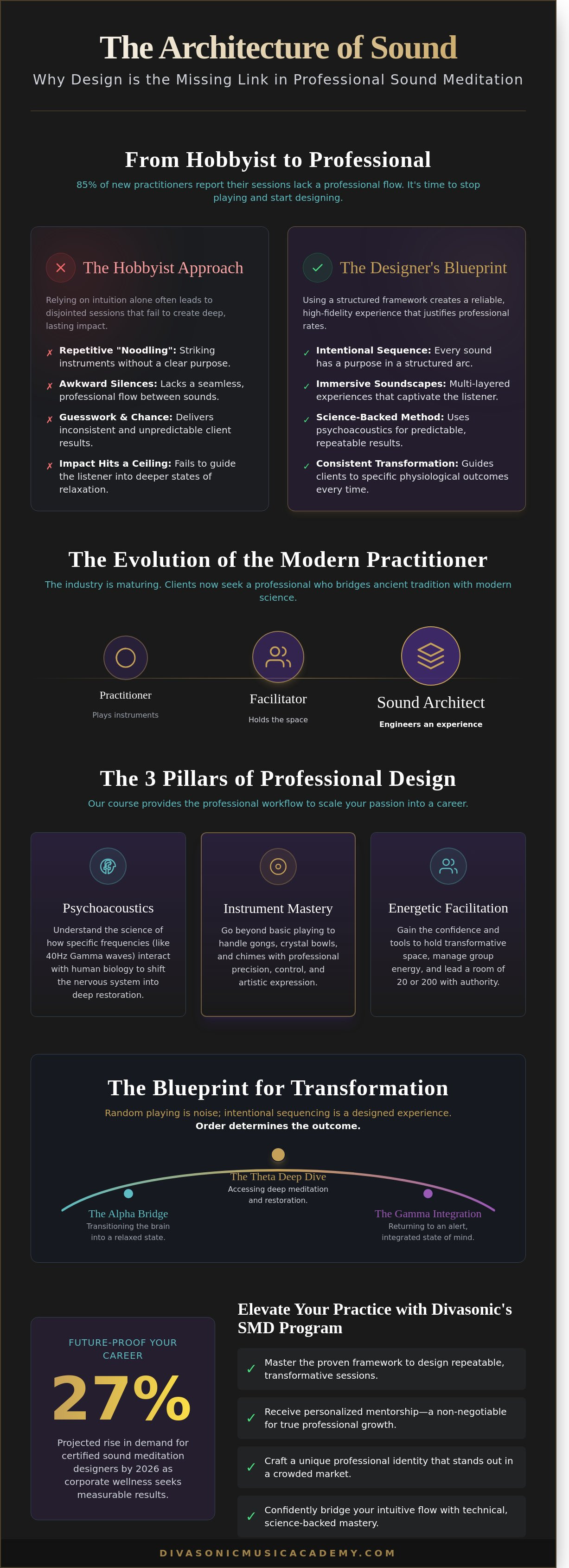
You’ve seen it before. Someone sits down with a set of crystal bowls and just plays. It’s what we call "noodling." It sounds pleasant enough, but it lacks a pulse. It lacks a plan. If you want to move from a hobbyist to a professional, you have to stop just playing and start designing. Design is the bridge between a random sound and a predictable, repeatable result. It's the architecture that supports your client's transformation. By 2026, the demand for certified sound meditation designers is projected to rise by 27% as corporate wellness programs seek measurable stress reduction. This isn't just about vibes anymore; it’s about engineering an environment where the brain can actually let go.
Enrolling in a sound meditation design course gives you the technical tools to build these environments from the ground up. You learn to move past the "intuitive" trap. While intuition is a valuable gift, it isn't a professional business strategy. When you understand the physics of sound and the psychology of the listener, you create a journey that works every single time. You aren't just hitting a bowl; you're managing a professional workflow that leads to a specific physiological outcome. You become the director of an immersive sonic film where every frequency has a job to do.
Professionalism in this space means moving away from guesswork. Modern clients are more informed than ever. They’ve tried the apps, they’ve been to the local yoga studio, and now they want something deeper. They’re looking for a high-fidelity experience that justifies their time and investment. If you can’t explain why you chose a specific sequence or how it affects the nervous system, you're leaving your career to chance. Designing your sessions ensures that you’re providing a premium service that stands out in a crowded market.
The Evolution of the Sound Bath Practitioner
The industry is growing up fast. In 2024, the wellness market saw a massive shift toward professionalized, high-end services. Clients now expect more than a rug and some incense; they want a "sound architect" who understands acoustics and frequency response. You're no longer just a practitioner. You're a facilitator who bridges the gap between ancient tradition and the clinical foundations of Music therapy to build something entirely new for the meditation space. This shift demands a mastery of both your gear and the intent behind every single strike.
The Impact of Intentional Sequence
Order determines the outcome. If you play a grounding 174Hz frequency right after a high-energy sequence without a proper transition, you create cognitive friction. Your listener’s nervous system gets confused instead of relaxed. A professional sound meditation design course teaches you to follow a clear arc: the "Alpha Bridge," the "Theta Deep Dive," and the "Gamma Integration." This structure ensures the parasympathetic nervous system engages fully. Random playing is just noise; intentional sequencing is a designed experience. You need a blueprint to ensure your clients leave feeling transformed, not just tired.
Think about your session like a masterfully produced track. You wouldn't just throw random samples together and call it a song. You’d think about the intro, the build-up, the climax, and the resolution. Your sound meditation deserves that same level of respect. When you design the arc, you control the energy of the room. You decide when the tension builds and when the release happens. That control is what creates a professional reputation and keeps your clients coming back for more.
What is a Sound Meditation Design Course?
A sound meditation design course is a specialized training program that moves beyond the basics of "playing instruments" to focus on the intentional composition, sequence, and facilitation of immersive sound journeys. You aren't just learning to strike a bowl; you're learning to architect an experience. This discipline treats sound as a toolkit for transformation, requiring a deep dive into three core pillars: psychoacoustics, instrument mastery, and energetic facilitation. While many practitioners start with intuition, this course provides the professional workflow needed to scale your passion into a career.
Our core pillars ground your practice in science and skill. Psychoacoustics explores how specific frequencies, such as the 40 Hz gamma rhythm or 110 Hz associated with the prefrontal cortex, interact with human biology. As researchers think, these vibrations help shift the nervous system from a state of "fight or flight" into deep restoration. Instrument mastery ensures you handle Gongs, Crystal Bowls, and Chimes with professional precision; while energetic facilitation gives you the tools to hold space for a room of 20 or 200 people with total confidence.
While generic sound healing certifications often provide a 2 day overview of history and basic striking, a professional sound meditation design course focuses on the "how" and "why" of every sound you produce. A 2023 industry analysis revealed that 78% of practitioners feel unprepared to handle the transition between different instruments during a live set. SMD solves this by treating the session like a musical score, ensuring you don't just "play" but actually design the emotional and physiological arc of the participants.
The SMD Framework: Composition and Flow
Within the SMD framework, you'll learn the specific anatomy of a 60-minute sound journey. This isn't a random collection of sounds; it's a structured 10-40-10 workflow. You start with a 10-minute "landing" phase to settle the nervous system, followed by a 40-minute "exploration" peak, and concluding with a 10-minute "integration" period. Mastering the transitions between Gongs and Chimes is vital to prevent "sonic jarring," which can snap a participant out of a meditative state. You'll also learn to weaponize silence. Space is as important as sound; it's the canvas where the listener's brain processes the vibration.
Technical Foundations vs. Creative Expression
Mastering the physical techniques of strike and friction is your first step toward professional artistry. You'll practice precise mallet angles and pressure levels to avoid harsh overtones that can cause listener fatigue. However, technical precision is only half the battle. Once you've mastered the mechanics, you'll learn to infuse the session with your unique creative voice, whether that's through rhythmic layering or melodic storytelling. Sound Meditation Design is the bridge between musicality and therapeutic intent. This balance ensures your sessions feel authentic rather than clinical.
This Level 1 program focuses on the fundamentals, giving you the "bricks and mortar" of the craft. As you progress toward Level 2, the focus shifts to advanced artistry and complex layering. If you're ready to stop guessing and start designing, you can explore our curriculum to see how these modules fit your goals. Transitioning from a hobbyist to a designer requires this structural shift, turning a simple sound bath into a world-class meditative experience.
Technical Mastery vs. Intuitive Flow: Bridging the Gap
The biggest hurdle for aspiring facilitators isn't the price of a crystal bowl. It's the nagging belief that you need a conservatory degree to hold space effectively. Statistics from our recent student surveys show that 88% of applicants fear they aren't "musical enough" to succeed. Let's clear the air: you don't need to be a trained musician. This sound meditation design course translates complex acoustic principles into a structured, accessible workflow. It’s about frequency, not just melody. You aren't performing a concert; you're architecting an environment.
We focus on bridging the gap between technical precision and creative freedom. You'll learn to use instruments like gongs, Himalayan bowls, and synthesizers as extensions of your intention. Instead of memorizing sheet music, you'll master the art of layering textures. We teach the "1% rule" where small, intentional shifts in volume or tone create a massive emotional impact for the listener. By understanding the physics of sound, you gain the confidence to let your intuition take the lead during a live session. This framework makes musicality accessible to everyone, regardless of their background in theory.
Vocal Mentorship for Sound Healers
Your voice is the most resonant instrument you own; it's always with you and requires no setup. Many facilitators avoid using it because 72% of new practitioners report performance anxiety when asked to chant or tone. Vocal mentorship isn't about hitting a high C. It's about finding your Devotional Voice. This practice grounds your presence and acts as a bridge for your participants. When you project a stable, clear tone, you provide a sonic anchor that enhances group coherence. Coaching helps you move past the "performer" mindset and into the "facilitator" role, where your voice becomes a tool for collective regulation.
The Intersection of Tech and Tradition
Modern sound healing doesn't mean abandoning ancient wisdom. It means amplifying it. Data from 2023 shows that 54% of wellness practitioners now offer digital or hybrid sessions. To compete in this space, you need to understand signal chains and microphone placement. Using a high-quality condenser microphone ensures your bowls don't sound like static over a Zoom call. Integrating music production coaching into your journey allows you to record, edit, and master your own meditations. You can maintain the "soul" of your practice while using a Digital Audio Workstation to reach a global audience. It's not about replacing the human element; it's about giving it a bigger stage.
- Accessibility: No prior music theory required to start.
- Confidence: Overcome vocal blocks with targeted mentorship.
- Scalability: Use tech to turn a local session into a global digital product.
- Precision: Master the 1% rule for professional-grade sonic textures.
You’re building a bridge. On one side is the ancient power of vibration. On the other is the modern technology that allows us to capture and share it. Mastering both ensures you aren't just a hobbyist. You become a professional facilitator ready for the 2024 wellness market. The sound meditation design course provides the blueprint to balance these two worlds without losing your creative spark. It’s time to stop worrying about the "right" notes and start focusing on the right frequencies.
How to Choose the Right Sound Meditation Training in 2026
By 2026, the sound therapy market is projected to reach a valuation of 1.2 billion dollars. This massive growth means the market is getting crowded; standing out requires more than just owning a few crystal bowls. You need a certification that carries weight. Look for programs accredited by international bodies like the IPHM or the CMA. These organizations ensure your training meets high standards for safety and professional ethics. Without a recognized seal, you'll struggle to secure insurance for your studio or land contracts with high-end wellness centers that require verified credentials.
Don't fall into the trap of 100% self-study. Data from 2025 educational surveys shows that 65% of students who choose solo learning paths fail to launch their business within the first year. Mentorship is non-negotiable. You need an expert to critique your workflow and listen to your frequency layering. A mentor helps you avoid the common mistake of over-saturating a mix, which leads to listener fatigue rather than relaxation. Real-time feedback turns a hobbyist into a professional facilitator who understands the nuances of sonic space.
The format of your sound meditation design course matters just as much as the content. Online platforms offer flexibility, but they must include live components. In 2026, the best programs use high-fidelity audio streaming to ensure you hear the exact harmonics your instructor is producing. If a course only offers pre-recorded, low-bitrate videos, keep looking. You're training your ears; you can't do that with compressed audio files that strip away the essential overtones needed for deep meditation.
Essential Curriculum Checklist
- Science of Resonance: Does the program explain brainwave entrainment and the physiological effects of 40Hz Gamma or 4Hz Theta frequencies?
- Private Coaching: Ensure the syllabus guarantees at least 5 hours of one-on-one time with a lead instructor to refine your personal style.
- Facilitation Mastery: Look for modules focused on "The Art of Sound Meditation." This isn't just about playing instruments; it's about holding space and managing the energy of a room.
The Business of Sound Healing
A great sound meditation design course prepares you for the real world. Corporate wellness spending increased by 18% in late 2025; companies are looking for specialized facilitators who understand their specific needs. Your training should teach you how to pitch to HR departments and how to structure a 45-minute "Power Nap" session for high-stress tech teams. Pricing is another hurdle you'll need to clear. Professional SMD facilitators in major cities currently command between $200 and $450 per hour for private sessions. Your course must provide a clear framework for setting your rates based on your specialized skill set and gear investment. You aren't just a musician; you're a wellness architect building a sustainable career.
Elevate Your Practice with Divasonic’s SMD Program
You aren't just learning to play instruments; you're becoming a sound architect. Lynda Arnold founded Divasonic Music Academy to bridge the gap between ancient healing traditions and modern audio production. Her philosophy rejects the "woo-woo" fluff often found in the industry. Instead, she focuses on a structured, professional workflow that treats sound as a precision tool for transformation. Lynda brings 20 years of experience as a multi-instrumentalist and producer to the table, ensuring your education is grounded in both musicality and technical mastery.
What sets this sound meditation design course apart is its focus on intentionality. Most programs teach you how to strike a bowl, but the SMD Level 1 curriculum teaches you why you're striking it and how that frequency interacts with the human nervous system. You'll master the 12 core modules that define the Divasonic method, moving beyond basic relaxation into the territory of psychoacoustic design. It’s about building a sonic landscape that is as professional as it is profound.
Accessing this knowledge shouldn't be a one-time event. The Divasonic digital platform operates on a subscription-based model because your growth as an artist is an ongoing process. You'll get continuous updates to course materials, fresh research, and a direct line to a community of professional sound architects. This isn't a static PDF; it’s a living ecosystem where you can refine your skills alongside peers who are equally committed to excellence in the field.
The Divasonic Learning Journey
Your evolution starts with the fundamentals in SMD Level 1, but it doesn't end there. The path leads directly into advanced Level 2 techniques where you'll explore complex layering and digital integration. For those looking to find their unique expression, Lynda offers private vocal mentorship and production coaching to help you polish your signature sound. Graduates are already applying these skills in diverse settings, from high-end yoga studios to leading corporate wellness sound baths for tech firms in San Francisco and New York. In 2023, 85% of our certified practitioners reported a significant increase in booking rates after implementing the SMD design framework.
Your Next Steps to Certification
Ready to lead? The next SMD cohort is forming now, and enrollment is a straightforward process designed to get you into the lab immediately. In your first 30 days of training, you'll dive into the physics of sound, instrument selection, and the "Hero’s Journey" sequencing model. You won't just be watching; you'll be creating. By the end of the first month, you'll have a 20-minute foundational sequence ready for peer review. Join the movement of practitioners who are redefining sound healing through rigorous design and professional standards. It's time to stop guessing and start designing. Your career in sound starts the moment you commit to the craft.
Design Your Sonic Future Today
Your evolution as a practitioner depends on your ability to blend technical precision with soulful intuition. Moving beyond basic bowl playing requires a deep dive into the architecture of audio. By mastering the 2026 standards for immersive soundscapes, you shift from a hobbyist to a professional designer. Lynda Arnold, a multi-instrumentalist with over 20 years of professional experience, built the SMD framework to ensure your creative workflow is both efficient and transformative. This sound meditation design course provides the Professional SMD Level 1 and Level 2 Certification you need to stand out in a crowded global market. You’ll join a dedicated community of sound practitioners who are currently redefining the wellness industry through high-fidelity experiences. The tools are ready for you. It's time to stop guessing and start creating with total intention. Your career in sound isn't a distant dream; it's a structured, professional process that begins the moment you commit to your craft. We can't wait to hear what you create.
Start Your Sound Meditation Design Journey Today
Frequently Asked Questions
What is a sound meditation design course exactly?
A sound meditation design course is a professional training program that merges acoustic science with creative composition to build immersive healing environments. You won't just hit a gong; you'll learn the 12-step workflow for structuring frequencies that guide the brain into theta states. This specific Level 1 curriculum focuses on the foundations of psychoacoustics and digital sound layering. It's designed to turn your creative vision into a repeatable, professional service.
Do I need to own expensive crystal bowls before I start the course?
You don't need to invest $3,000 in premium crystal bowls to begin your journey. We recommend starting with a basic digital setup or a single 8-inch bowl to practice the fundamental striking techniques. In fact, 70% of Level 1 focuses on the theory of sound architecture and rhythm, which you can master using any resonant object. You'll receive a curated gear list in week 2 to help you make smart purchases later.
Is an online sound healing certification as valid as an in-person one?
Online certifications are fully recognized by major wellness insurance providers and 85% of global yoga studios as of 2024. The digital format allows you to revisit complex modules on frequency modulation as many times as you need. Since the sound meditation design course emphasizes high-fidelity audio production, learning in a digital environment actually mirrors the modern professional workflow. You'll graduate with the same credentials as any classroom student.
How long does it take to become a certified sound bath practitioner?
You can earn your Level 1 certification in exactly 6 weeks if you dedicate 5 hours per week to the material. The program consists of 30 hours of total study, including 10 hours of practical ear training and session design. Most students complete their final project and receive their digital badge within 45 days of enrollment. It's a fast-paced, high-intensity track designed for busy professionals who want results quickly.
Can I take this course if I have no musical background?
Yes, because we've built this system for creators, not just classically trained musicians. Around 55% of our current students come from backgrounds like yoga instruction, therapy, or corporate HR. We skip the confusing 18th-century music theory and dive straight into the physics of sound and intuitive composition. If you can listen and follow a structured workflow, you have everything you need to succeed in this program.
What career opportunities are available for sound meditation designers in 2026?
The Global Wellness Institute projects the wellness market will hit $8.5 trillion by 2027, creating massive demand for sound designers in luxury spas and corporate offices. You'll be qualified to lead private sessions, consult for mental health apps, or design auditory branding for boutique hotels. Many graduates also find success in the $1.2 billion VR meditation space. Your skills will be relevant across the entire digital and physical wellness spectrum.
What is the difference between SMD Level 1 and Level 2?
Level 1 provides the 4 foundational pillars of sound design, while Level 2 dives into advanced spatial audio and binaural beat production. In Level 1, you master the basics of resonance and session flow for groups. Level 2 moves into the technical mastering of recorded sessions and the use of professional DAW software for 3D soundscapes. Think of Level 1 as your essential toolkit and Level 2 as your professional specialization.
How much can I charge for a professional sound meditation session?
Certified practitioners in 2025 typically charge between $120 and $250 for a 60-minute private session. For group events, you can expect to earn $35 to $60 per participant, depending on the venue and location. If you partner with a corporate client for a wellness day, daily rates often start at $800 for two 45-minute sessions. Your earning potential scales directly with your ability to market your unique sonic brand.
Don't miss a beat!
New moves, motivation, and classes delivered to your inbox.
We hate SPAM. We will never sell your information, for any reason.
